| History | Current Status | Future Hopes |
| Vision Statement | Mission Statement & Goals |
“UNICORN” stands for the following, and more:
- Universal Neomedieval and Illustrated Cyberspace Opportunity for Realistic Needs
- Unbounded Neverland and Infinite Collection of Online Retroactive Neomedievalism
- United Never Intimidated Corny Ornery Revelers of Neomedievalism
- Undergraduate Neomedieval Instruction Capable of Online Renewable Narration
- University Novel Instruction Concerned Over Reality and Neomedievalism
- Unrealistic Nerds Involved in Concentrations Over Realistic Neomedievalism
- UNICORNs!
The UNICORN Castle strives to both learn and teach about the world during the period 500-1500 CE, both as it most likely was and as it has been since imagined. In so doing, the UNICORN Castle recognizes that this period, particularly the European Middle Ages, has been exploited since 1500 CE for oppressive economic and political purposes, including to promote colonization, slavery, autocratic governments, and fascism. All UNICORN Castle games and other tools strive to promote the vision and mission of the UNICORN Castle, as well as to serve as teaching tools.
How it all started:
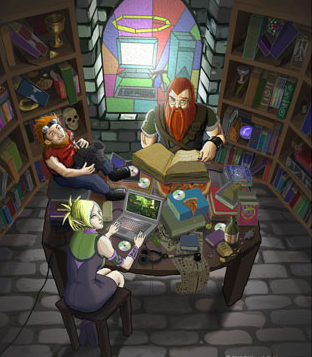
Artwork by William J. Robinson, © 2010
Several years ago, Carol Robinson worked with Mark Natale to try to build small exhibits for her Literature in English I class (British Literature before 1800) at Kent State University—Trumbull. They used UNITY to attempt to build a “3D” exhibit of the Ruthwell Cross, with the intention that students could “walk” around the cross and examine it via their avatar selves. They had mild success in their attempts, mostly due to time and work constraints.
A couple of years later, Carol Robinson and Pamela Clements (Siena College, US), who were the Chief Leaders of Medieval Electronic Multimedia Organization (MEMO) at the time, together wrote an invited proposal for a “video game styled archive” of medievalist works. Consider the image of the three individuals working together (left); it is an image that Medieval Electronic Multimedia Organization used for its book cover, among other items. One might imagine the young woman with the laptop computer and the young man with the video camera to be graduate students of contemporary medieval studies (including medievalism), and the older gentleman might appear to be a rather eccentric archeology professor. Such an approach that addresses the exciting scholastic opportunities provided by online technology while fighting to maintain the dignity and diligence established by more traditional scholarship. They proposed to build a virtual museum that was also to be a library (very similar to the now established Minecraft Uncensored Library), that had a Great Hall for special exhibits and conferences, that provided classrooms and workrooms, and that even had a store. In short, it would provide a three dimensional style environment for both research and pedagogical purposes—with gaming elements for exploration and learning. The advantages of a platform such as this included: instant updating of information, access to books and journals, access to video, images, and other digital multimedia, and a digital virtual space for conferences and meetings to hold discourse. Scholarship relies more and more upon audio-visual sources, and this museum-library-store could easily link scholars to film clips, musical passages, artwork, and artifacts, as well as to sites outside, such as Chaucer MetaPage or The Old English Aerobics Anthology (recognizing the pointlessness of reinventing “the wheel”). Such a platform, too, would allow for more frequent and constructive engagement on both formal (conference) and informal (gaming) levels and on a global scale.
While that proposal was not accepted (it turned out that the publisher was not ready to go beyond paper print publishing) the ideas continued to germinate. In the late Spring of 2014, long done with their first published book anthology and not interested in moving forward with print publications of that nature, the members of MEMO decided to take the virtual museum project on as the organization’s central production. Carol Robinson worked with Lesley Coote (University of Hull, UK) to design and seek grant funding for building the UNICORN Virtual Museum of Medievalism and Medieval Studies. Carol Robinson and Helen Young (Deakin University, AUS) began experimenting with offering jointly taught international courses and supporting online sessions for various medieval and medievalism conferences; the museum supported online sessions for International Society for the Study of Medievalism (ISSM) and The Middle Ages in the Modern World (Andrew Elliot, Conference Chair). In August, 2015, Carol Robinson was diagnosed with cancer and the museum went into hiatus. In August, 2018 Carol revived and began working with Lauryn Mayer (Washington and Jefferson College) to revive the museum, which is now a castle.
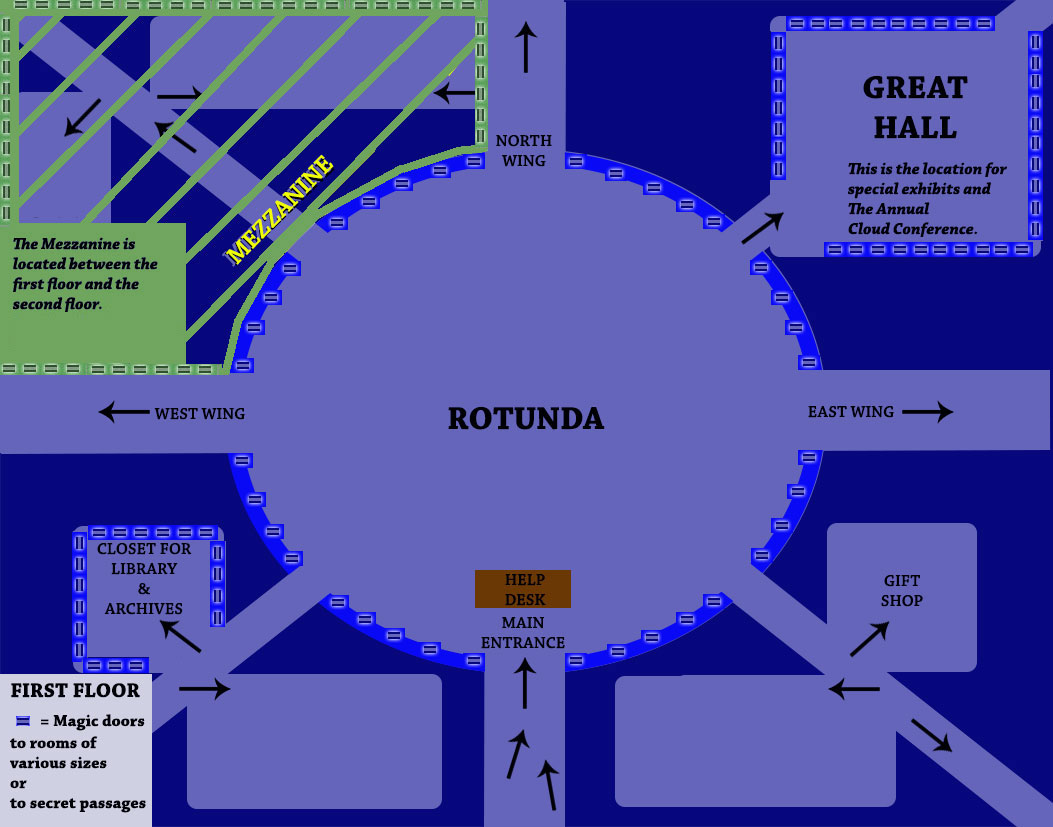
Entrance map, designed by Lesley Coote and Carol Robinson
Return to Top
Right now . . .
The UNICORN Castle promotes the growth of two types of structures:
A Museum: scholars are invited to help build this museum, creating exhibits that teach—both creative works from and/or historical facts about—a particular place during the period 500-1500 CE. The exhibits must adhere to the vision and mission of the UNICORN Castle. Occasionally, the Museum also serves to support and even host academic conferences, such as the 2023 International Conference for the Study of Medievalism.
A Bunch of Games and Other Tools: Members of the UNICORN Task Force are working on several gaming projects. One of the first games developed, The UNICORN Castle Haunted Museum originated as a table-top game, but the ultimate goal is to convert this into a video game. The game began to take shape in the virtual form of three online environments in Mozilla Hubs: The Haunted Cinema, The Haunted Carnival, and The Haunted Village. One experimental game, The Quest for the Endowed Chair (created by Carol Robinson, Carol Jamison, and Lauryn Mayer) was developed in this environment, in The Haunted Cinema.
The UNICORN Castle is a community in which researchers are able to participate equally, understanding that scholarship is practiced by individuals working in many different conditions and with varying degrees of support for their work. We value the involvement of researchers at all career stages, and across the full range of difference within the academy, and we especially welcome newcomers to our community. The organization aims to be a supportive and safe professional environment for all those interested in the study of both factually-based and creative works representing any part of the world between 500 and 1500 CE—as long as those works do not promote the oppression or suppression of other voices (including those voices that are themselves oppressive). The UNICORN Castle supports people, especially those from communities traditionally marginalized in contemporary world—including but not limited to people of color, women, disabled people, LGBQTIA+ people, and members of all faiths—to share their research and develop both professional and non-professional networks within an environment that prizes inclusivity, generosity, and courtesy. The UNICORN Castle refuses to accept bullying and harassment of any kind, whether intellectual, institutional, or personal.
Return to Top
Some day . . .
The UNICORN Castle will become an online environment that exists both as a textual and virtual (“3D” animated) world. Founded by former members of the now defunct Medieval Electronic Multimedia Organization, which featured the now defunct blog The Medieval in Motion, this castle invites all interested groups and organizations, from amateur explorers to scholars, to join us in this venture of creating a public learning experience in cyberspace. One day, organizations will be able to build halls of exhibits (or single exhibits in a shared hall) that will be open and free to the general public. Embodied as avatars, anyone will be able to roam the halls to explore these exhibits and participate in special exhibitions and tours (that may or may not be free of cost). Scholars and artists may work behind the public “halls” to further research or participate in creative endeavors. But remember: the castle is haunted by the ghosts of medieval people and characters!
Return to Top
Vision Statement
The UNICORN Castle is, above all else, a place for creative learning about the world as it existed between 500 and 1500 CE. We strongly embrace the fun of medievalism(s) and fantasy. We also strive to combat misrepresentation and abuse of what facts we have about various parts of our world during this period.
Mission & Goals
The mission of the UNICORN Castle is to support innovative and inclusive interdisciplinary scholarship in the study of and play with both factual and fictional elements representing the world as it existed (or didn’t exist) between 500 and 1500 CE, and beyond. We encourage a broad investigation into this expansive range of phenomena, discourses, and media across diverse geographies. We encourage open and inclusive dialogue on these subjects. We encourage conversations about the function of studies of and playing with the varied comprehensions of the works and history of this period all over the world. This is both a place of active research and learning (a museum) as well as of play (a video game). The creators and other contributors are activists in support of voices that have not always been heard, valued, or amplified.
The UNICORN Castle strives to:
→ Promote the highest level of scholarship about particular events and works that existed between 500 and 1500 CE.
→ Encourage creative play with these events and works.
→ Counter the appropriation of the period for oppressive philosophies and politics.
→ Be collaborative, accessible and inclusive of diverse populations in our contemporary creative or scholarly representations and engagements.


 BY: credit must be given to the creator.
 NC: Only noncommercial uses of the work are permitted.
 ND: No derivatives or adaptations of the work are permitted.