What does a dwelling look like, where is it, what surrounds it and what is it made of?
Who lives here, and how do they use this space? Who or what comes in and out, invited or not invited, welcome or unwelcome? When and why?
What is the history of this place, how far has it remained the same or has it changed over time? Is it/will it still change?
Does the dwelling reflect the status, the occupations of the people who live in it? Are they happy here, or not?
Each house (or any kind of dwelling) and the people, beings or household within it, is a little ‘world’ amongst other little worlds. What is that world like?
Here are some medieval and later houses in English towns and cities:
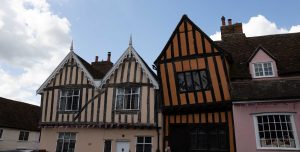
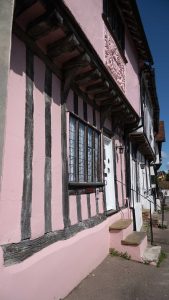
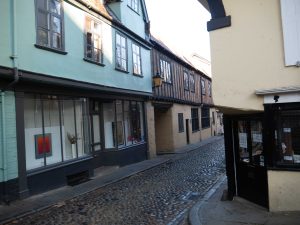
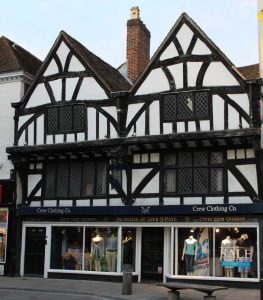
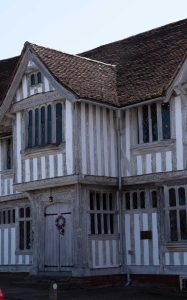
These houses in Lavenham, Suffolk (‘wool’ town) and Norwich, Norfolk (one of medieval England’s richest and most important cities) show the ‘terraced’ effect of building in urban settings, even for important citizens. As today, land prices were at a premium in desirable urban locations, so people built on some very narrow plots, then build second and third storeys if they could afford to.
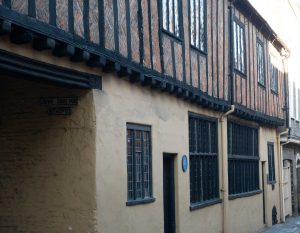
The wealthier the owner, the longer the main street frontage of the building; a long street front was a status symbol, as was decoration: this house on Elm Hill in Norwich (which you can see in the wider-angle picture above) dates from the early sixteenth century, and was owned by Austin Steward or Styward, Lord Mayor of the city at the time of Kett’s Rebellion in 1549. It was built on the site of another, fifteenth-century dwelling, the city home of Sir John Paston (of ‘Letters’ fame), who was also a Norwich alderman (top member of the city council).
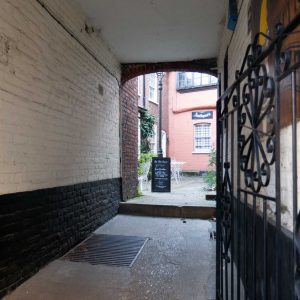
Such houses were not small… an archway would lead into a central courtyard, surrounded by other wings of the house, and these particular houses also had large gardens, leading down to the River Wensum. This archway in Norwich’s Bridewell Alley leads into such a courtyard, around which was arranged the home of another fifteenth-century Lord Mayor.
Below is John a Port’s house, another fifteenth-century building belonging to one of the richest citizens of Salisbury, county town (now city) of Wiltshire – more ostentatious and ‘showy’ than the Norwich houses, but evidence that there was a great deal of regional variation in ground planning and decoration.
Exterior decoration and painted woodwork could also be used to show status:
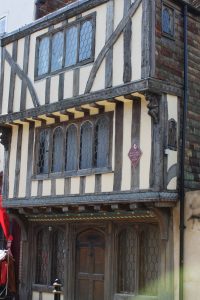
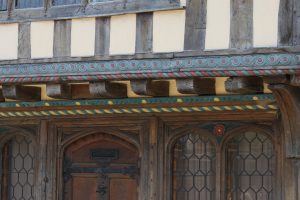
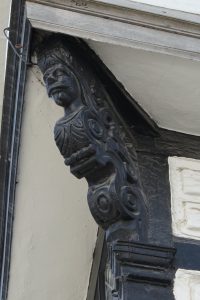
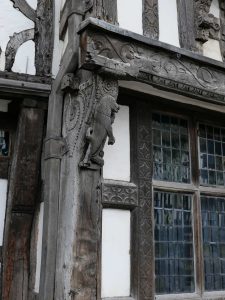
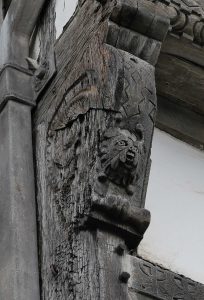
There are still quite a few of these examples in existence, although they are usually sixteenth- or early seventeenth-century, as these examples from Canterbury (above) and Stratford-upon-Avon demonstrate. The exterior color gets restored from time to time, so will usually be nineteenth-century or modern.
Some more examples of medieval/early Tudor to early Stuart houses (these, unlike nineteenth-century and more modern examples, are not consciously ‘medievalist’… the building of houses on timber frames with wattle-and-daub – basically woven paneling with plaster infill – continued until the second half of the seventeenth century, when stone and brick replaced it in towns):

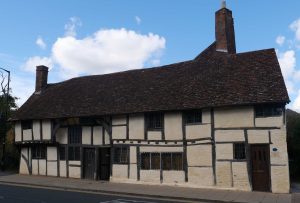

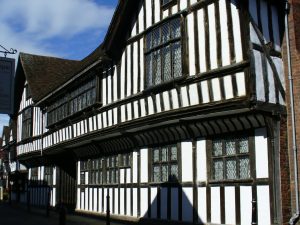
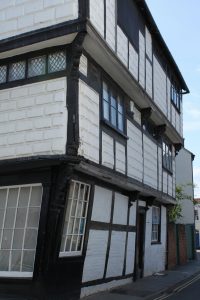

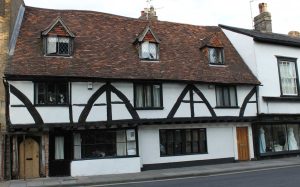

(top row, Stratford-upon-Avon, second row, Worcester – the Greyfriars, third row; Canterbury – the early 1600s King’s School building, bottom row, Salisbury)

This long, galleried building in Stratford-upon-Avon is the town’s early sixteenth-century grammar school, where William Shakespeare first encountered Ovid’s Metamorphoses...its many windows lit up the students’ workplaces.
Interiors:
Most representations of medieval interiors show the space inside the home as sparsely furnished; this is true, as only the necessary tables, seating and beds were required for everyday life, along with cookware, implements for cutting and feeding, and work tools. Richer people might have a cupboard to keep and display valuables – including spice if wealthy enough, or a chest to lock them in (as the Wife of Bath notes to her fourth husband). Those who could afford it might also have a prie-dieu, or prayer stool, and devotional furnishings such as a rood (crucifix), a rosary, some candles on a stand and a Book of Hours. Books of hours came in several different price points, from super-economy to premium and de luxe (the ones with the gilded illustrations)!
The interior of Lavenham Guildhall is now a museum to the wool trade which made the town rich in the long Middle Ages, although the sparse furnishings are pretty accurate for a medieval house, although there would probably have been a table in the main hall. Guildhalls were often built originally as upmarket houses, which then got taken over by guilds for their members’ meetings.
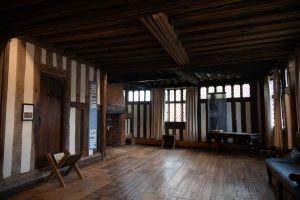

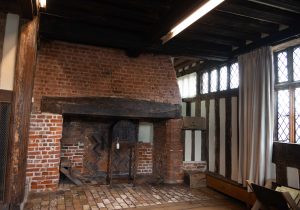
What we see now are usually the houses of the more wealthy members of ‘long medieval’ society. Even these are usually presented in audio-visual and digital media as plainly or not at all decorated. This is NOT quite so accurate:
This is Kentwell Hall just outside Long Melford in Suffolk, built originally by the local lord, Sir John Clopton in the 1490s. It has been substantially remodeled by his early sixteenth-century successors, but at the side can still be found the ‘Moat House’, which dates from the fifteenth-century building. It’s the half-timbered section in these pictures (note it’s infill is brick, not wattle-and-daub): 
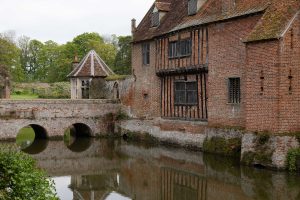
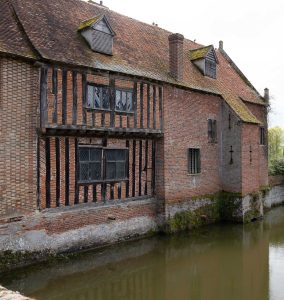 It’s what we might call a one-room apartment, above the stable and brewery – it’s sparsely furnished but plain it is not…

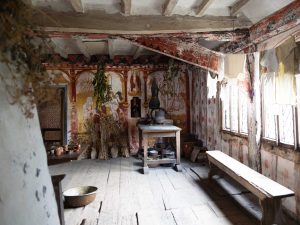
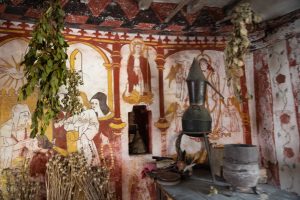
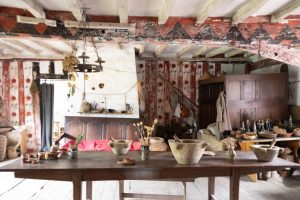
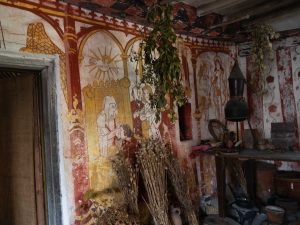
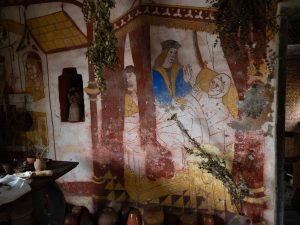
Most of these images are religious and/or moral in nature, another interesting fact to note about the lives of medieval people… they were a sneeze or a twinge away from the grave most of the time, so the afterlife was a very real presence for them.
Most of the colors are derived from mineral or plant extracts, with only one blue image standing out from the rest, evidence that there has been some ‘restoration’. As the servant of a very important local governor, the tenant may have had access to the painters of the local church, which Clopton also financed. Wealthier people, of course, had tapestries or painted cloths to decorate their walls. These, like wall paintings, are ephemeral and so easily lost to us. This is one survivor, the so-called Buxton Cloth which once decorated the walls of fifteenth-century Strangers’ Hall, once the home of a wealthy Huguenot cloth worker in Norwich:
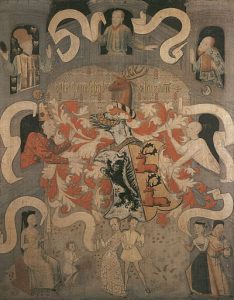
It dates from the third quarter of the fifteenth century.
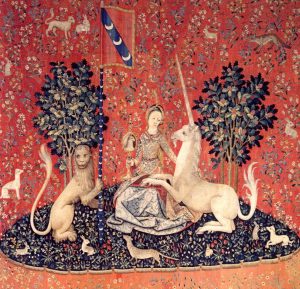
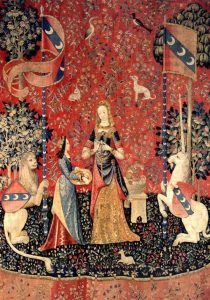
Tapestries, being very expensive indeed, have survived in greater quantity, but mostly later examples from the sixteenth and seventeenth centuries. A famous example is the Unicorn Hunt sequence now in the Cloisters museum in New York, but the most beautiful is La Dame a la Licorne in the Museum of the Middle Ages in Paris:


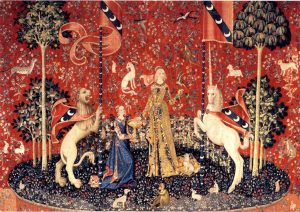 ]
]
The theme is the five senses, and it’s believed that the whole sequence was an expensive wedding gift from a bridegroom for his bride. Only the most wealthy could afford tapestries. These tapestries at Cotehele House in Cornwall are seventeenth- and eighteenth-century rather than medieval, but they demonstrate the effect of being in rooms richly hung with cloth:
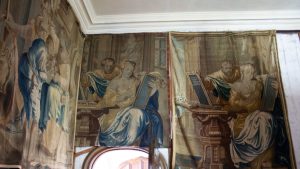
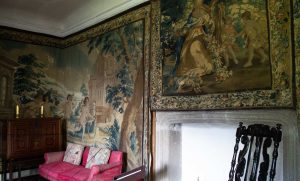
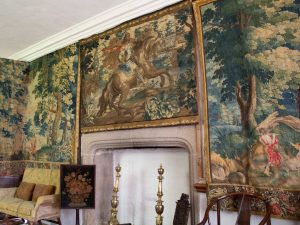

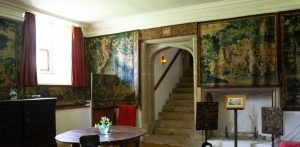
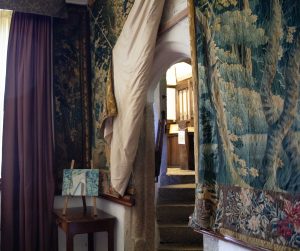
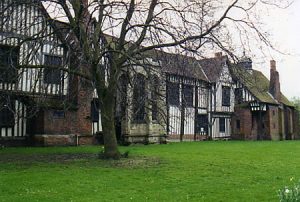
The medieval hall of Gainsborough Old Hall in Lincolnshire is still largely intact; it was built for the franklin Thomas Burgh after he was knighted in 1461, most likely dating from the 1470s. Unfortunately the walls no longer have any decoration or hangings…
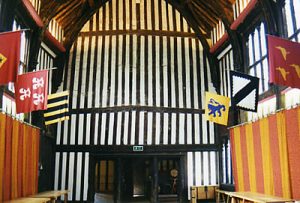
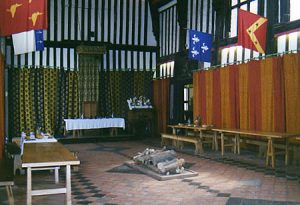
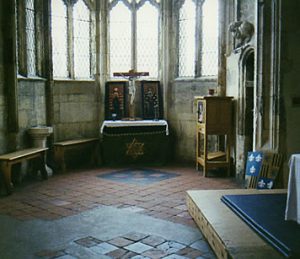
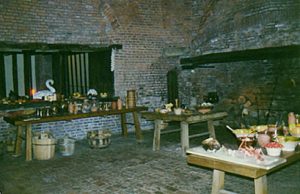
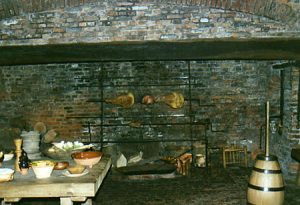
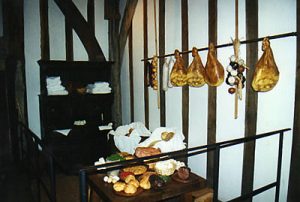
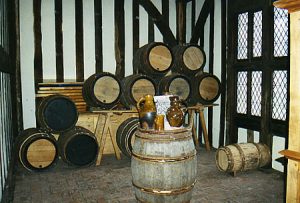
The whole has been reconfigured with modern reproductions of medieval ‘stuff’, with a fake feast in the kitchen, a pantry and a wine store. The hall’s window recess has been envisaged as a worship space, although there would probably have been a separate room for this, or a chapel. In the wall there are three entrances from the ‘screens passage’ where the servants or performers waited before being granted entrance to the hall.
This is very grand, for a man who once entertained Richard III… the old manor house at Burton Agnes in East Yorkshire is smaller and less pretentious. It was built in the fourteenth century with a large cellar on the lower ground floor; the roof was added in the fifteenth by Sir Walter Griffith. The later and much grander Burton Agnes Hall was built in the sixteenth century on a new site by the side of the old manor.
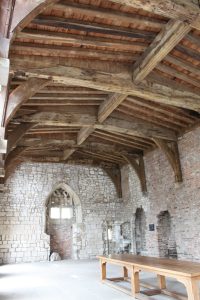
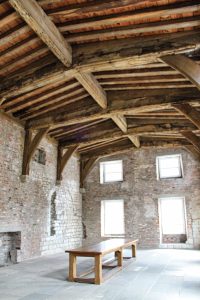
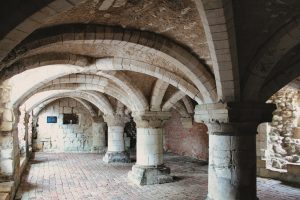

To amuse themselves in their breaks, the builders made a basic Nine Men’s Morris board in one of the pillars, where it can still be seen.
The re-furnishing of medieval interiors (some say in the fashion of a stage set) is one form of medievalism. Neo-medievalism is more playful and eclectic, more catholic and possibly random in its selections. A really good example of this can be seen at Snowshill Manor in Gloucestershire. The manor house, with some of its wooden roofs, dates from the sixteenth century. After World War One it was purchased by Charles Paget Wade, who employed Arts and Crafts Movement architects and designers to reconfigure it as a repository for his ever-growing collection of old and exotic ‘stuff’.
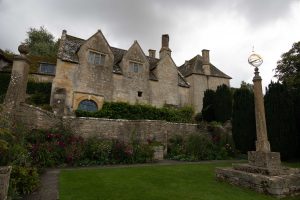
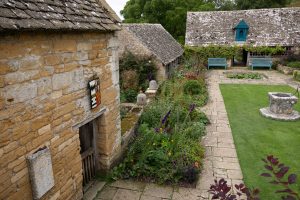
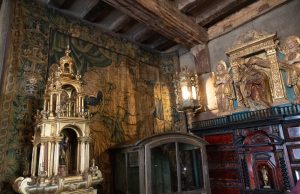
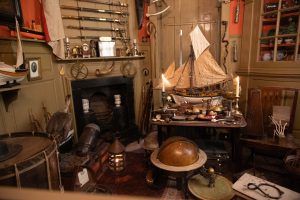
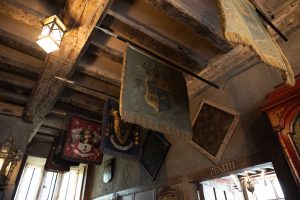

It came from everywhere, all periods, all shapes and sizes. Everything has been taken out of its context and away from its intended purpose, then placed in a collection that (kind of) randomly fills this Tudor space, as though it somehow ‘fits’. Later in his life Wade lived alone but not in the house… he lived in a ‘chapel’ building, another very neo-medieval space:
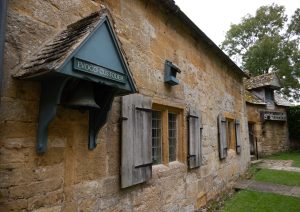

 He would wear the red ‘priest’s’ robes on an everyday basis. He was more than a little eccentric, and liked also to put on amateur dramatic productions, when he dressed up like Shakespearean characters, both on and off the stage.
Snowshill is interesting also for its connection with the West Indies. The Wade family lived on their sugar plantation in St Kitts. Wade continued to draw on this wealth after he moved to England, and his collection is therefore built on the labor of enslaved people. Wade’s first wife Mary was a black lady, originally his housekeeper with whom he already had a child when they married in 1855. His was a mixed race household, and Snowshill offers a direct connection between medievalism and slavery.