It may help to look at some terms from Film Studies, and the techniques which they describe, to help with the creation of ‘visuals’.
Some Film Terms with Explanations:
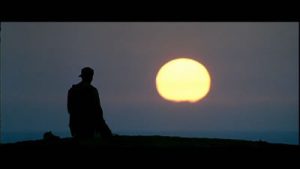
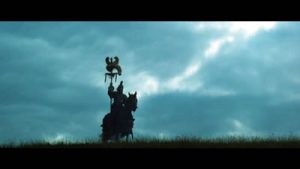
BACK LIGHTING – the scene is lit from behind the actors, causing a silhouette, and sometimes a ‘halo’ around the figure/s. This tends to isolate characters and make them more important in the scene. There may be a supernatural implication to this.
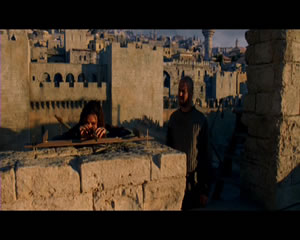
(below: in this shot from Kingdom of Heaven, we see the awesome greatness of medieval Jerusalem and share the wonder of the two characters. In an iconic scene, Fuqua’s Arthur appears backlit on the horizon as legendary hero, to save the Britons from the Saxons.)

BACK PROJECTION – images are projected behind the actors, so they appear to be somewhere other than on a sound stage or film set, eg street scenes. Digitally this can be changed, or a character ‘moved’ into a different setting (perhaps as a consequence of a choice or an accident – ie treading on something, gaining control of an object, going through a portal…). CGI has made this much easier in post-production.
(below: Ridley Scott’s technique involves taking existing infrastructure eg the walls and gates of Jerusalem, the Colosseum in Gladiator… and adding ‘medieval’ features in CGI. In that way, the corporeality of the existing material anchors the CGI in the ‘real world’.)

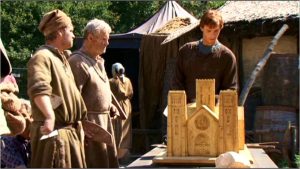
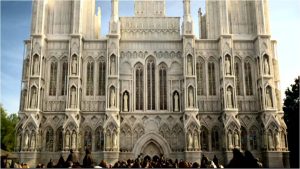
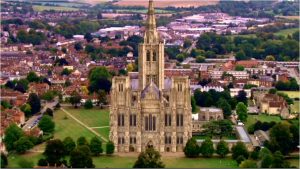
The technique is used as narrative by the Scotts in their TV series Pillars of the Earth. To show the gradual building of Kingsbridge cathedral, the existing Salisbury cathedral is broken down, basic elements retained and gradually rebuilt, until the final scene fades into a drone shot of the cathedral at the time of filming, linking the twelfth century with the twentieth. As has been said already, ‘when is now?’

BRIDGING SHOT – the same scene changes to show the passing of time. With a SOUND BRIDGE, the same sound continues into the next shot, linking the two. Seasons are a good example of this eg the same tree with green and brown leaves and no leaves.
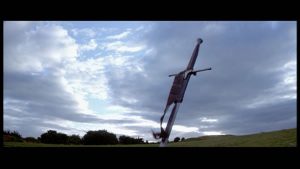
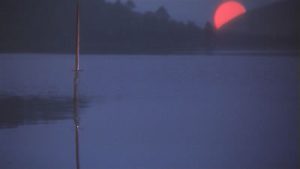
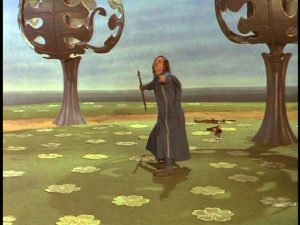
(below: In Excalibur, John Boorman reproduces a version of J Arthur Rackham’s death of Arthur and Mordred in three dimensions, with the addition of a red disc for the sun, setting in blood. The same disc is seen in the final scenes, as the Lady of the Lake’s arm retrieves the sword to take it away from the ‘world of men’. The red sun acts as a visual bridging device between the two scenes, sharing their ‘tragic sunset’ meaning.)

CHIAROSCURO – the lighting shows heavy contrast between light and shade. This is mostly used in monochrome (and why shouldn’t a gameworld, or part of it, be mono) to highlight the ‘black-and-whiteness’ of the whole. It generally produces ‘difference’.
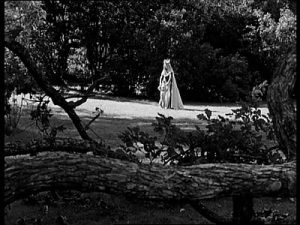
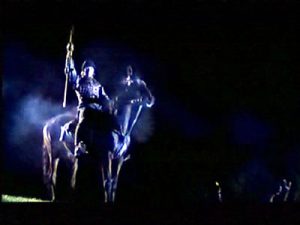
(below: Ingmar Bergman highlights the unreality and the beauty of the Virgin and Child in a Seventh Seal dream sequence by bathing them in light: dream sequences are usually shaded and shot in soft focus. In color, Leslie Megahey also uses deep contrast in a dream-like sequence, using spotlighting to create a more threatening ‘horror’ effect – in The Hour of the Pig. In Lancelot du Lac, Robert Bresson, who worked in mono during his early career, uses a similar technique to show the isolation and deep despair of King Arthur.)

CLOSE-UP An image in which the subject fills most of the frame and little of the surroundings is shown. Typically, a CU will be of a person’s face/expression. A head/shoulders shot is a MED(IUM) CU. Often used for conversation, or to highlight a character’s feelings, responses or ‘inner life’. It focuses the viewer’s attention solely on that person.
CUT The most common transition between shots, made by splicing/joining the end of one shot to the beginning of the following one. A sense of the dramatic is conveyed if a number of brief shots are cut together in a whole series, as FAST CUTTING. Battle scenes usually intercut fast shots like this with slower-moving concentration on small sections of the battlefield with one or two characters in more intimate focus. Sam Peckinpah uses fast and slow in his action scenes (eg The Wild Bunch) to great effect. It highlights incidents of violence that he wants to stress.
(A JUMP CUT moves quickly from one shot to another, in such a way that you notice it, and a MATCH CUT moves from one shot to a very similar one; the most famous being the cut from space station to floating bone in Kubrick’s 2001). These, of course, create opposite effects.
CA = CUTAWAY. A shot which briefly interrupts the visual presentation of a subject to show something else – useful for making a quick, telling association. This technique was used at the very beginning of film-making by Georges Melièzes, who demonstrated that different associations could be used to create narratives or feelings in the mind of the viewer. He made the same objects cut to different sets of ‘things’ or facial expressions in order to create a variety of narratives around the same image.
CROSS-CUTTING (or SHOT/REVERSE-SHOT). Alternating shots that follow the exchanges in a dialogue, switching back and forth between two speakers. These are often at eye level, and create the impression of close connection, even if the two actors are being separately filmed at different times.
DEEP FOCUS. The lens is deployed so that items at the back of the frame are in focus, as well as at the front. This enables characters or objects at the back of a scene to be ‘brought forward’, or to have more importance than if they were blurred.
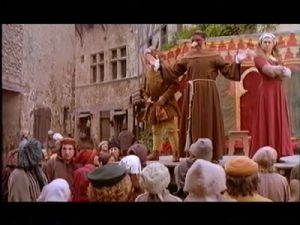
(below: a crowd scene from Hour of the Pig… the actors, including the main characters, are shown in focus in the crowd, but Megahey also wants us to focus on the actors on stage, and the ‘medieval’ setting behind. He uses deep focus in court and gallows scenes, too. Eric Rohmer’s Perceval le Gallois is filmed almost entirely in deep focus in order to preserve the ‘medieval-ness’ of the staging.)
DIAGETIC SOUND comes from within the frame; it is a consequence of the action you see (ie the sound of a hammer, and someone hammering). If it comes from OUTSIDE the frame, either as a sound effect or musical score, it is NON-DIAGETIC.
DISSOLVE Or, more accurately: LAP (= ‘Overlap”) DISSOLVE. A transition between shots in which one shot begins to fade out as the next shot fades in, overlapping the first shot before replacing it. Typically used to give a change of scene-setting.
DUTCH ANGLE Camera angle which ‘skews’ the image from the vertical/horizontal of the picture frame. Doors may appear slanted, etc., producing a deliberately disorientating effect. This can be used to give impressions of mental disturbance, or indeed any disturbance.
ESTABLISHING SHOT. The opening shot, which sets the scene for the rest of the film. The establishing shot is extremely important; it can establish the mood of the whole work, give basic information about setting and characters and introduce a world and its inhabitants. It’s really worth giving a lot of thought to this part. Very often in films the scene begins with a wide panorama, then homes in on part of it, often involving the main character/s, to show their ‘place’ in this world.
FADE Fade In – Fade Out: the effect of changing the image gradually from black to full visuals, or the reverse (typically, in old films, at the end). Usually creates the feeling of a beginning and an end, or a change.
FRAME – OPEN. The subjects move freely in and out of the frame, which does not set a border to the action. This gives the impression of a wider world outside the shot.
FRAME – CLOSED. The subjects are contained within the frame, which does set a border to the action. This concentrates the viewer’s gaze on the characters and/or objects within the shot.
FX = (Sound) Effects: sounds in the film other than music or dialogue. Best kept for really significant events.
HAND-HELD – the camera is not stabilised, and so gives a jerky effect. This can be replicated digitally – it gives an air of ‘authenticity’ or ‘truth’.
HA = High Angle: a shot giving a view of the subject from above. This diminishes the subject.
LA = Low Angle: a shot giving a view of the subject as seen from below eye-level. This exaggerates the subject and makes them appear more important. It can make small things/characters look big (as in Mel Gibson films)!
MISE-EN-SCÈNE – that which is contained within the frame, and how the director moves it around. This is really important… what’s in the frame is all you have to work with, although you can give the impression of more outside it by using an ‘open’ frame. When writing or creating, you need to have an idea of what’s outside the frame. Does this image make the viewer/reader/player interested to see more? What’s in focus and what isn’t? How does the light affect the scene? What will capture the viewer/player’s attention and stimulate their imagination and interest? If in color, remember that warm colours (reds, yellows) step out of the image, whilst cool colors (blue, grey, green) recede. Cool colors give the impression of more space, whilst warm colors reduce it. What stands out and what doesn’t?
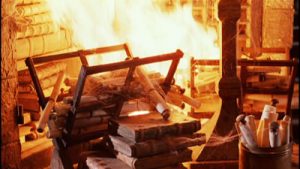
(below: the hot colors of fire contrast with the blues of a night sky and the darkness of the abbey buildings in Name of the Rose. It renders them more powerful and dangerous, as they ‘jump out’ at the viewer.)
MIX A combination on the sound track, for a particular effect, of music, dialogue and/or FX. Copyright is often a problem here.
MONTAGE – editing, but stresses the ‘building up’ rather than the ‘cutting up’ of the film. ACCELERATED MONTAGE is a sequence of edits which become shorter and shorter, useful for the passing of time on journeys, charging into battle, arrivals, etc.
OVER THE SHOULDER – the back of the subject is seen in the front of the shot. Accentuates the ‘point of view’ of the subject. Used in FPS (first person shooter) games a lot.
PAN ‘Panning’ is the effect achieved when the (stationary) camera pivots horizontally to take in a panoramic image. This expands the ‘world’ that the viewer/player sees. It can be used to surprise – for example… who’s behind you? Anthony Mann used this a lot, for example in the barn scene in El Cid.
POINT OF VIEW – we see the shot as through the eyes of a character, as in ‘over the shoulder’ shots.
PULL BACK – the camera pulls away from the subject. Sets them in a landscape or scene, can be used to inform or surprise. It make the character become smaller and less important.
REACTION SHOT – shows characters’ reaction to what’s going on or being said, rather than the speaker or the action itself. Can indicate a response about to happen – or not…
REVERSE ANGLE – switching to the other side in a conversation or action – see SHOT REVERSE SHOT
SEQUENCE A consecutive series of related scenes, acting as a major story-telling unit.
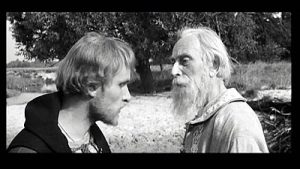
(below: Andrei and Theophanes the philosopher – who isn’t really there, because he died a long time before – debate… the story of their differences of opinion don’t need words in Tarkovsky’s narrative frames. From Andrei Rublev; in this film about Russia’s famous icon painter, almost every scene is its own little icon.)

SHOT – an unbroken, uncut piece of film, no edits. Long ones can be useful to prolong excitement or to give time for the viewer/player to think about what they will do next, or to consider outcomes.
SOFT FOCUS –using a filter which makes the outlines go fuzzy. Used for dream sequences, to introduce ‘romance’, flashbacks, thought processes. Or movement to past time.
TRACKING – Filming while the (track-mounted) camera is moving. The view stays with the characters as they travel along. Increases connection between viewer/player and subject, and increases excitement. Can create a sense of anticipation if not all is revealed at once, eg Leni Riefenstahl following Hitler’s plane in Triumph of the Will. (Love or hate it, she knows how to use her ‘effects’ to the best advantage, and works her way through a wide variety of those listed here).
WIDE ANGLE – a broad-angle lens, which brings a wide panorama into shot, without panning. A very broad angle lens, which distorts the picture by ‘bending’ the subject, is called a FISH EYE, eg Alan Rickman looking into the camera in Robin Hood: Prince of Thieves.
WIPE – A transition between shots, usually between scenes, in which it appears that a shot is pushed off the screen by the next shot: usually, a vertical SHARP or BLURRED line moves across the screen, literally ‘wiping’ out the previous shot and replacing it with the next one. Not generally used digitally, but it could be. Highlights the artificial nature of the process.
ZOOM Use of a zoom lense to cause the image of the subject either to increase in size as the area being filmed seems to decrease (ZI = Zoom In), or to decrease in size as the filmed area fills the screen (ZO = Zoom Out). Zooming enables the view to ‘home in’ on characters or objects within the scene. It demonstrates the nature of their involvement in whatever is happening around them eg a battle, a sea voyage, a flight. Zoom lenses also have the capacity to bring objects in a row closer together, so that the gap between them is reduced or negated altogether.
To these effects we should now add HYPERTEXT. This enables the viewer/player to ‘fall through’ the surface scene or text by selecting something on screen, to find another layer below it.
Form, structure and therefore cinematography are very important in the presentation of fantasy, including medievalist fantasy. Here are some screen shots to (hopefully) give an idea of this:

(High and low angle: low angle makes the subject look larger than life, good for heroic speeches as here in Robin Hood, Prince of Thieves – the Kevin Costner scene reworks a similar scene from the earlier Adventures of Robin Hood, starring Errol Flynn;
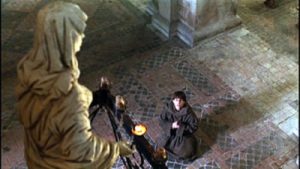
In The Name of the Rose, young monk Adso pleads with the Virgin Mary to save a condemned ‘heretic’ girl… he looks very small, and his facial expression of pleading and helplessness is spotlit… the Virgin stands powerfully above him, filling the frame on the left. It shows her power [and maybe her stony implacability] and his humanity and weakness).
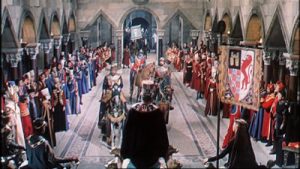

(In a further development, the panoramic high angle shows a landscape or crowd from a position of power… in this case the powerful individual – the king of Castile in El Cid – and a general crowd scene of Danaerys Targaryan’s wedding in Game of Thrones. The latter is a familar way of setting a scene, usually followed by the cameral ‘homing in’ on a particular part of the scene in question, an event or major characters. The audience feels ‘in control’ of the storyworld, an illusion which can then be complicated or shattered in some way. Opening, or establishing shots are usually panoramic high-angle shots; the camera then homes in, or cuts, to a related scene or a part of the scene. The same method is often used for battle scenes. It isn’t a new idea in itself – Homer uses it throughout The Iliad!)
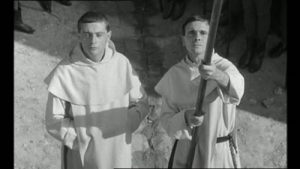

(The high and low angle shot can be used in connection with shot-reverse-shot to convey points of view and emotions, as it’s used here by Robert Bresson in the final scenes of his Passion de Jeanne d’Arc. The director shows us how the young victim sees the young friars on the ground, and how they see her, looking up at her tied to the stake where she is about to be burned to death… as the camera switches from one to the other).
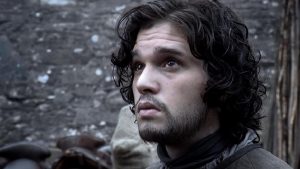
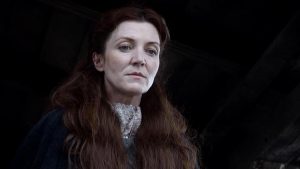
(Another instance of this from Game of Thrones: Jon Snow’s facial expression is highlighted as he looks pathetically and helplessly up at Catelyn Stark, his adopted ‘mother’, and she looks down on him with hatred and disdain. The camera angles give her the position of power, and the eye level shot places the viewer down on the ground with Jon, allying us with him).
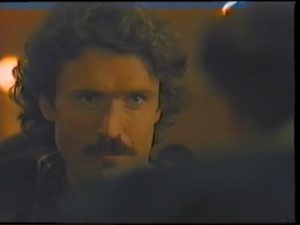
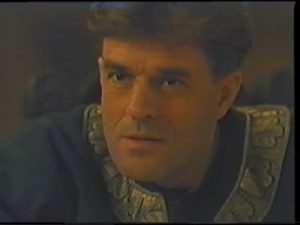
(Classic shot-reverse-shot allied with over-the-shoulder positioning, so we take up the viewpoint of each character as they listen to what the other has to say. The shadowy atmosphere conveys intrigue, conspiracy and threat, highlighted by the low spotlighting of the characters’ faces, and the actors’ direct gazes… Robert and the sheriff threaten one another in John Irvin’s Robin Hood).
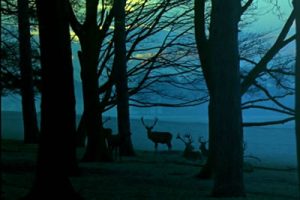
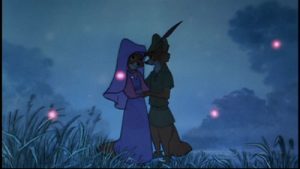
(More uses of atmospheric ‘soft focus’ and natural or low light: John Irvin uses this to create a view of an ‘olde English’ forest, whilst Disney uses it in a cartoon to create an intimate love scene for Robin and Marion from Disney’s Robin Hood. Both scenes evoke a dream-like quality, whilst the blue-tinged background makes them recede from the viewer’s own position. We are invited to be in the scene but we cannot be, and so nostalgia and ‘romance’ are created.)


(Showing both sides of a conversation at the same time, in close-up, is a quick way of revealing relationships between characters – Ned and Benjen are close; they trust one another and listen attentively, whilst Cersei Lannister’s face tells us exactly what she thinks of Catelyn, the Starks and being in their home – from Game of Thrones. And of course, she knows precisely where her husband is, ‘looking up’ the dead love of his life.)
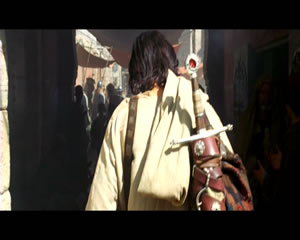
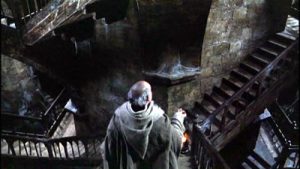
(Back views as the camera ‘tracks’ an actor through a scene: hand-held cameras follow Orlando Bloom into Jerusalem in Kingdom of Heaven at head height, giving the viewer an idea of hustle and bustle, whilst a similar camera follows Sean Connery from above, into the labyrinth of the monastic library where he is in danger, in Name of the Rose, highlighting suspense.)


(The camera acts as a person, revealing a character and almost [but not quite] breaking the ‘fourth wall’: it creeps towards Arya Stark, whose pained face, awkward hold on her embroidery frame and hunched physical stance shows her discomfort at her situation. As it approaches her from behind, she looks up, the surprise on her face made more apparent by carefully-placed lighting.)

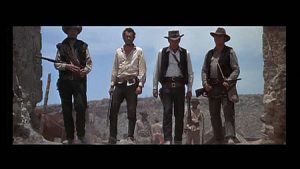
(Actors in a row stride toward the a camera held directly in front of them… an image of resolution, defiance and brotherhood in A Knight’s Tale… this iconic form of shot is derived from Sam Peckinpah’s western The Wild Bunch.)
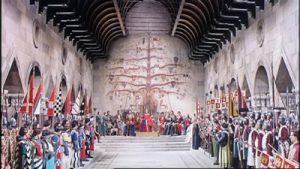
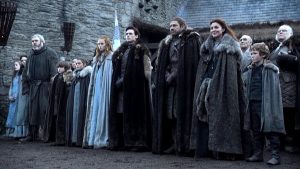
(Group shots – Anthony Mann has the camera move from a high-angle panorama where it ‘flies’ along at roof height, from where it is then lowered to face the Castilian royal family head on. The genealogical tree painted on the wall behind them is a master stroke by this wonderful director of epic – they are rooted in their family history, and entrapped by it. The film that follows [El Cid] will have ‘family’ as its major theme. In Game of Thrones we meet the Starks in a line, filmed from a slightly lowered angle… they fit into their landscape and are also closely bound… lacking a rich historical background, the camera and the actors have to do the ‘heavy lifting’. It doesn’t work so well…the characters are less closely bound by their lineage; their ties are more personal and the family won’t hold so closely together).

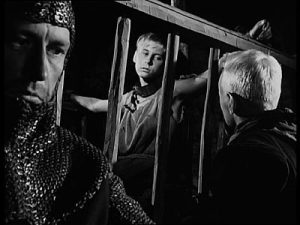
(Images of entrapment and control associated with the oppression of women: Mann places Jimene and Urraca behind slatted windows, whilst the bars of a cart form the prison for the condemned witch in Ingmar Bergman’s Seventh Seal. Constrained characters often look through windows, with the camera in front or behind).
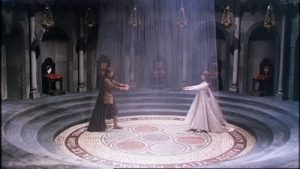
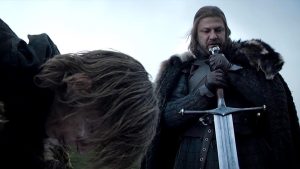
(Other forms of constraint and powerlessness… the doomed love of Rodrigo and Jimene in El Cid is captured by their enclosure in a circular ‘amphitheatre’ as if buried underground, with rays of light shining down on their hand-fasting embrace, themselves (like the lovers) constrained – by the perimeter of a circular opening above. They offer love and light, but not freedom. Outside factors will not kill their love, but they will harm and kill their lives. The doomed deserter in Game of Thrones is in the foreground of the shot, whilst Ned Stark stands over him in an iconic Romanesque ‘soldier’ pose, the sword Ice in the foreground representing both death and justice. The force of the gloved hands shows determination and reveals that there is no way out. The viewer, however, identifies with the in-focus head in the foreground, sensing the fragility of both head and life – in the next few shots of the sequence it will be severed. We sense the fear, the violence and the injustice of this justice.)
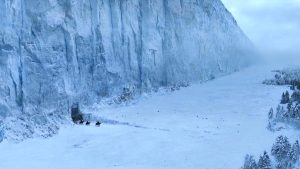
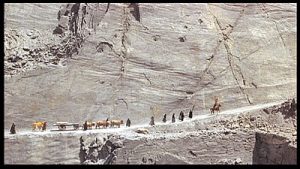
(Tiny people in an epic landscape: in epic the landscape is a major character, and shrinking the human form within it demonstrates that. The ice wall in Game of Thrones dominates the screen, and therefore the lives of the tiny people coming out of the tunnel. It arouses feelings of cold, fear and isolation of both the group and the individual. Similarly, the arid landscape through which mourners trudge with King Richard’s coffin in Donner’s Robin and Marian does something similar, whilst also highlighting the aridity and emptiness of idealism, Crusade and faith.)
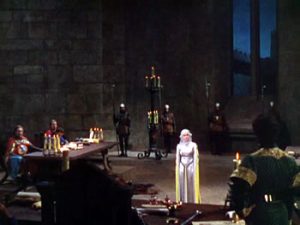
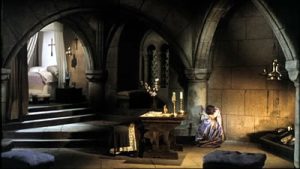
(Alone-ness…darkness and aridity are frequent backdrops for scenes of loneliness, despair and isolation. In a scene from The Adventures of Robin Hood, Marian stands in a dark dungeon-like space, in a white and gold costume which stresses her innocence and her righteousness [a ‘virgin Mary’ icon], whilst the desperate Jimene collapses and weeps in a dark corner of her chamber… lit only by the available light of her candle. The bright hope offered by her cross and empty marriage bed are in the far distance; she has to climb stairs to reach them, and she’s not able to.)
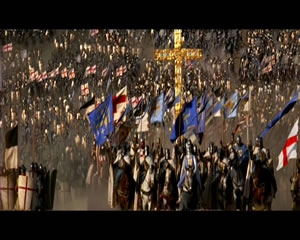
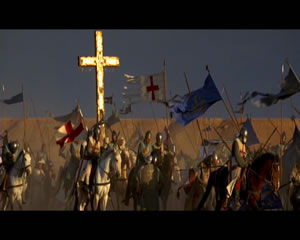
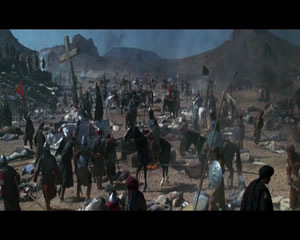
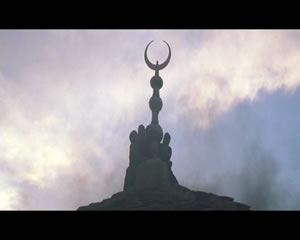
(Use of a symbol – in Ridley Scott’s Kingdom of Heaven the ‘ideal’ of power and glory that the Crusader kingdom of Jerusalem represents are symbolised by the great golden cross carried before the king (although the idol has feet of clay, as Baldwin is a leper who hides his face behind a silver mask). Still golden but in retreat, the defeated knights flee Saladin’s army with the cross that now represents the final hope that they cling to. The wooden, tarnished cross is carried off by Saladin’s army, it’s gold plating removed to show its tawdry fragility; an obvious metaphor for the Latin kingdom. In the penultimate scenes of the film, the cross is taken down from the top of the basilica and replaced with an Islamic crescent. Symbolism gives a strong theme and structure to the film as a whole, with these scenes reminding the audience of the film’s ‘spine’.)
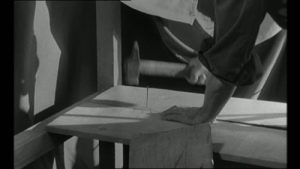
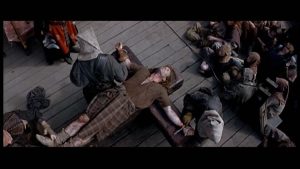
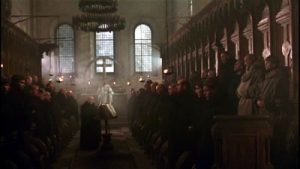

(Some other uses of ‘cross’ imagery: Bresson links the martyrdom of Jeanne d’Arc to Christ’s crucifixion by the use of ‘hammer and nails’ imagery, as the carpenters build the scaffold on which she will be burned, whilst Mel Gibson’s death of William Wallace leaves almost nothing to the imagination – the link is pretty obvious as well as historically pretty rubbish, but he wants to make sure we don’t miss the point. The power of the imagery is lessened, though, by the obviousness. As the monks celebrate mass in The Name of the Rose, the cross which should be the centre of their worship sits pathetically at the end of the shot, subordinated by everything around it, rendered meaningless for these so-called ‘religious’, whilst the cross imagery of kissing the sword hilt – so important to medieval knights and crusaders – is reduced to a perfunctory gesture by Robin and the sheriff in Robin and Marian; these two ageing men don’t even know why they’re fighting… they just feel that they should.)
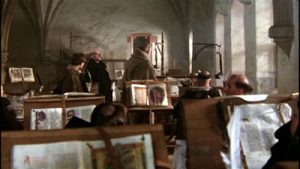
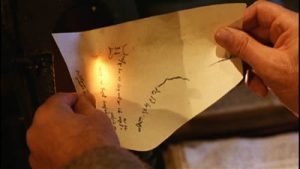


(Light is very important in The Name of the Rose, which is a very ‘dark’ film aesthetically as well as morally. The light of the intellect and of learning – represented both by the library and the person of William of Baskerville – is set up against the moral darkness of the monks and the Catholic faith as a whole. The scriptorium is filled with light, and the light of a candle helps William to unravel a most important clue to finding a serial killer. In other scenes the fire that burns down the library is comparable to the fire with which the so-called ‘heretics’ will burn – it is also a destructive fire which burns not only knowledge but innocent faith such as that of Adso, the young novice monk.)
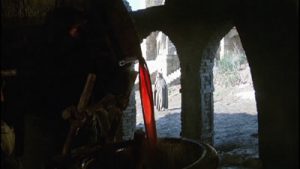
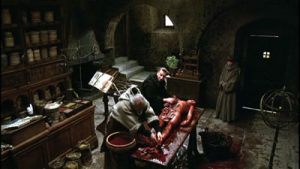
(and colour…in a film often shot in darkness, blue light and soft focus, the bright red of blood and the bright colours of the abbot’s treasure stores [and his grain hoard] -representative of his immoral, un-Christian greed – take on sharper form and meaning. Here we see the blood of a victim on the autopsy table and the blood pouring from a cauldron to make pudding for the monks’ table … life literally and metaphorically snuffed out and life consumed.)