
Three types of game narrative, simply applied:
- The linear narrative.
- The non-linear narrative.
- The branching narrative.
1)
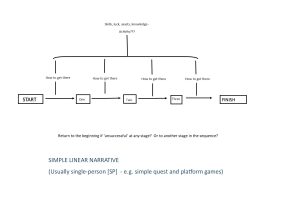
The linear narrative (as in simple ‘quest’, ‘mission’ or platform games) are the simplest form to begin with. There is a ‘successful’ end goal, which the player must attain to complete the game, or to progress to a higher level.
The game may have different levels of difficulty, but each will have its own end goal for the player to complete.
Means of motion and the successful completion of each stage of the game may differ, but the end goal will have been decided by the creator.
Characters may ‘die’ or fail at any stage, in which case the player will have to begin the game again from the start.
The player may be able to select different personas with a variety of attributes and abilities rather than this being pre-set by the creator.
The stage scenarios will have been pre-set, and the tasks to achieve them will also have been set by the creator, but a variety of different alternatives (e.g. collecting assets, gaining and using skills, acquiring information…) may be used to enable forward progress within the game.
2)
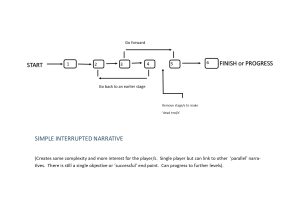
Non-linear narratives introduce a few more complexities and enable the creator to use more varied content, objects and context.
The narrative will begin in a similar way to (1), but a wrong decision, turn or ‘failure’ at a given stage may lead to reversal of a player or character’s progress. In this case, they must return to an earlier (pre-decided) stage of the game and must therefore re-take some stages. Content could also be changed at this point (the tasks may change in nature and/or content, for example, or the player may lose a skill, strength or asset). Similarly, a player or character may be allowed to by-pass a further stage, or stages of the game (for example, as a reward for some successful extra task or a higher level of ‘success’ in a task), or they may be given extra power, skills or assets for a particular ‘success’. The end goal will still have been predetermined by the game’s creator.
3)
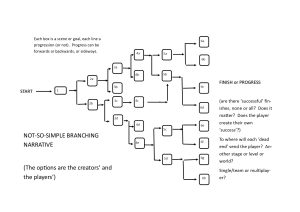
Branching narratives are the most flexible and potentially creative form of game (most commercially successful high-end games fall into this category). They may be as short or long as the creator wishes, with an infinite number of mutations, levels, multiverses and game scenarios. Players can be free to choose a level, scenario and persona to play, and will be rewarded with satisfaction, even if there is no predetermined ‘successful’ goal. With many possible finishing points, the creator may select one finish, or more than one for ‘successful’ completion, or there may be no ‘right’ ending … or the player may be allowed to select one (as in ‘multiple mission’ game choices). Although the possibilities seem endless – and may be – quality of experience needs to be maintained throughout, as the player should be satisfied with their experience and feel a sense of achievement when reaching a finishing point – even if it isn’t what they expected! These game narratives contain all the elements of the other two games, but they expand on these to create a whole storyworld.
 Media are not necessarily self-contained, so a whole or part of a game world may be selected and transformed for another medium –
they can be literary (prose or poetry), audio-visual, artistic or dramatic/performative (or anything else you can think of).


It’s your storyworld, so you can get creative
…and do what you want with it!
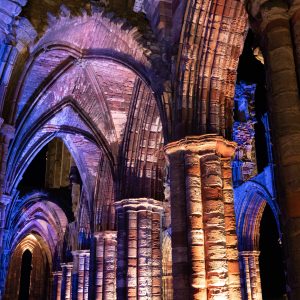
(light show on Whitby headland…the transforming power of color)