
by Carol L. Robinson
Kent State University
Medievalism is the reception, interpretation, and reimagining of the Middle Ages (roughly 500–1500) in post-medieval periods. It is not the study of the Middle Ages themselves, but rather how later eras—including our own—construct, idealize, or use the “medieval” to express ideas in art, literature, politics, and popular culture. —Wikipedia
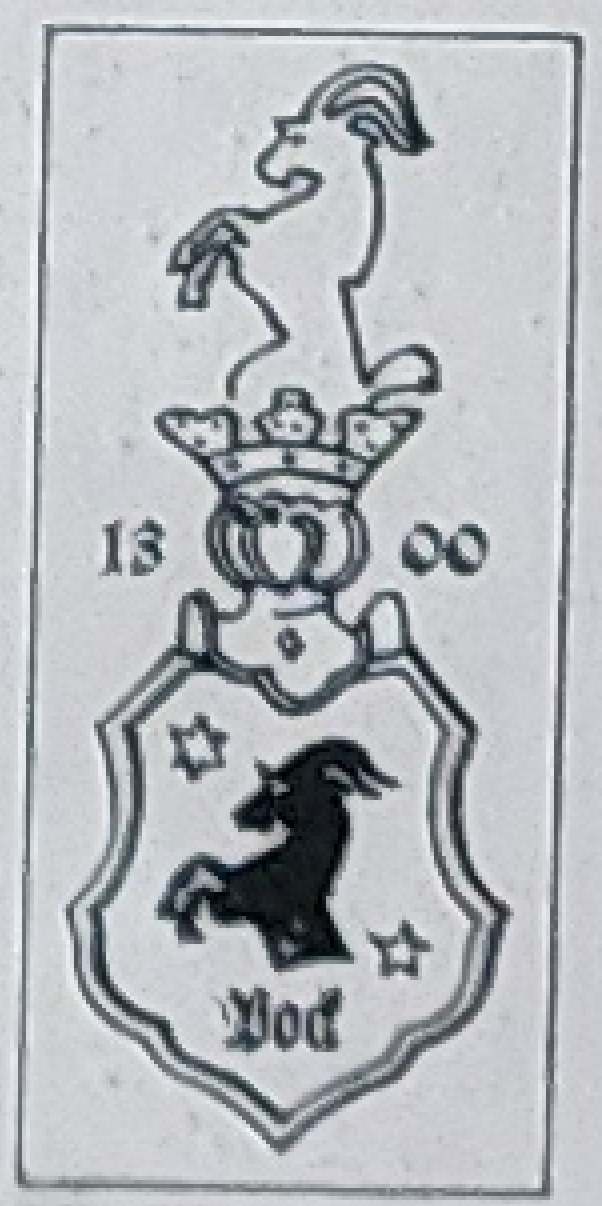
Fig. 1: Bock Family Crest
When I was growing up, my grandmother spent hours and hours telling us family stories. Several of these stories were centered around her father (my great grandfather), Adam Bock, who immigrated to the United States from Germany in 1905. He was an artist (carving sculptures out of marble), but he was also a baron. A baron is a member of the lower nobility. In Germany, a baron was ranked just below the level of a count—a “free lord” of the empire, a vassal reporting directly to the monarch. Historically, in Germanic countries, a baron was made responsible for land granted from the monarchy. In England, after the Norman Invasion (1066), barons became the very bottom of nobility! Today, the title is little more than an aristocratic status. (In fact, in 1919, Germany abolished all legal privileges.) Hence, now that my family is here in the United State, this title is completely meaningless on both a political and economic level. However, my great grandfather, on the boat to the United States, had snuck the documents in, secured underneath a dresser drawer (I’m told). Why did he do this? Perhaps for nostalgic purposes, for pride? The family Bock coat of arms featured a goat (!?). The crest, which is situated on top of a knight’s helmet, is designed after that white goat on the top of Figure 1. The Bock shield had the silhouette of a goat with two stars (see Fig. 1). This coat of arms is medieval. My family clinging to this coat of arms is medievalism.
The fascination with the medieval, with what we define as being medieval (or “medievalish”) has existed since the Middle Ages “officially” ended. Studies in Medievalism, “the oldest academic journal dedicated entirely to the study of post-medieval images and perceptions of the Middle Ages,” has devoted annual volumes of historical, cultural, political, and aesthetic (literature, film, video games, other arts) analysis since 1979. The International Society for the Study of Medievalism has devoted years of conference presentations at a variety of venus (inspiring book and article publications), founded The Year’s Work in Medievalism, and helped found Studies in Medievalism.
Let’s remember, however, that the Middle Ages traditionally describes an historical period unique to Europe. What was happening during the years 500-1500 C.E. on other continents of the world was not considered medieval. The term medieval, in other words, has traditionally been a Eurocentric term—never recognizing what was happened in the rest of the world during that period in history. Studies of global medievalism examine how the European Middle Ages have been perceived, understood, interpreted, imagined, represented, and misrepresented on a global scale. For example, some studies examine how icons and other symbols of the European Middle Ages have been used (exploited?) for contemporary national identity, political power, and cultural expression.
This is where medievalism in practice collides with medievalism in theory. Medievalism theories attempt to examine post-medieval expressions, to categorize them and understand them as they function within contemporary society. Take a look at the titles of various issues of Studies in Medievalism, and you can see these angles: Medievalism in Scholarship and the Arts, Medievalism in Europe, Medievalism in North America, Defining Medievalism(s), Defining neomedievalism(s), Postmodern Medievalisms, Corporate Medievalism, Ethics and Medievalism, Medievalism on the Margins, Medievalism in Play, (En)gendering Medievalism, Ecomedievalism, Medievalism and Discrimination, Politics and Medievalism, Appropriating the Middle Ages: Scholarship, Politics, Fraud, . . . . Also take a look at a relatively younger journal, Postmedieval (est. 2010), which “publishes theoretically driven scholarship on premodernity and its ongoing reverberations. Contributions are characterized by conceptual adventure, stylistic experiment, political urgency, or surprising encounter.” Less structures (more fluid) in its approach, this journal’s titles include: When did we become post/human?, The Medievalism of Nostalgia, Disability and the social body, Cognitive Alterities/Neuromedievalism, Premodern Flesh, Comparative Neomedievalisms, The Holocaust and the Middle Ages, Making Race Matter in the Middle Ages, Archistecture of Colonizers/Architecture of Immigrants, Thinking Across Tongues, Queer Manuscripts, Feminist intersectionality: Centering the margins in 21st-century medieval studies, Legacies of medieval dance, . . . .
In other words, theories of medievalism(s) analyze how the medieval is received in later (post-medieval) times. These theories are angles of examination. For example, one of the more recently developed theories is Global Medievalism. As Helen Young wrote in her 2022 book, Global Medievalism, “Global medievalism is an ongoing process of retelling the Middle Ages that disputes centuries’ worth of hegemonic medievalism.” Likewise, Angela Jane Weisl and Robert Squillace published Medievalisms in a Global Age (2024), an anthology of essays that “explore the many facets of contemporary medievalism: post-colonial responses to the enforced dissemination of Western medievalisms, attempts to retrieve pre-modern cultural traditions that were interrupted by colonialism, the tentative forging of a global “medieval” imaginary from the world’s repository of magical tales and figures, and the deployment across borders of medieval imagery for political purposes.”
One final thought: you are examining medieval literature from the perspective of a 21st century student. That, too, is a form of medievalism: the act of comprehending the contents of medieval British manuscripts is the act of bringing those representations of the medieval into your contemporary world. How do you bring them into your world? Your understanding of these works is filtered by a lens spanning in time from 500 C.E. and limited in width to a very small region of Europe. Here you are: sitting in your comfortable chair, reading these words on your computer (or smartphone), trying to imagine what it was like to listen to Geoffrey Chaucer reading from The Canterbury Tales to a live audience. It is impossible to imagine without recogizing the fact that you are understanding his words as filtered through the culture (technology, aesthetics, politics, etc.) of your North American world(s). After all, how a student from the Great Lakes region appreciates medieval irony is not going to be quite the same as how a student from the Deep South Atlantic coast appreciates medieval irony—particularly looking at it from a 21st century perspective. As a student of medieval British literature, you are a student of medievalism in practice, theoretically.