Supplemental Pages:
Introduction
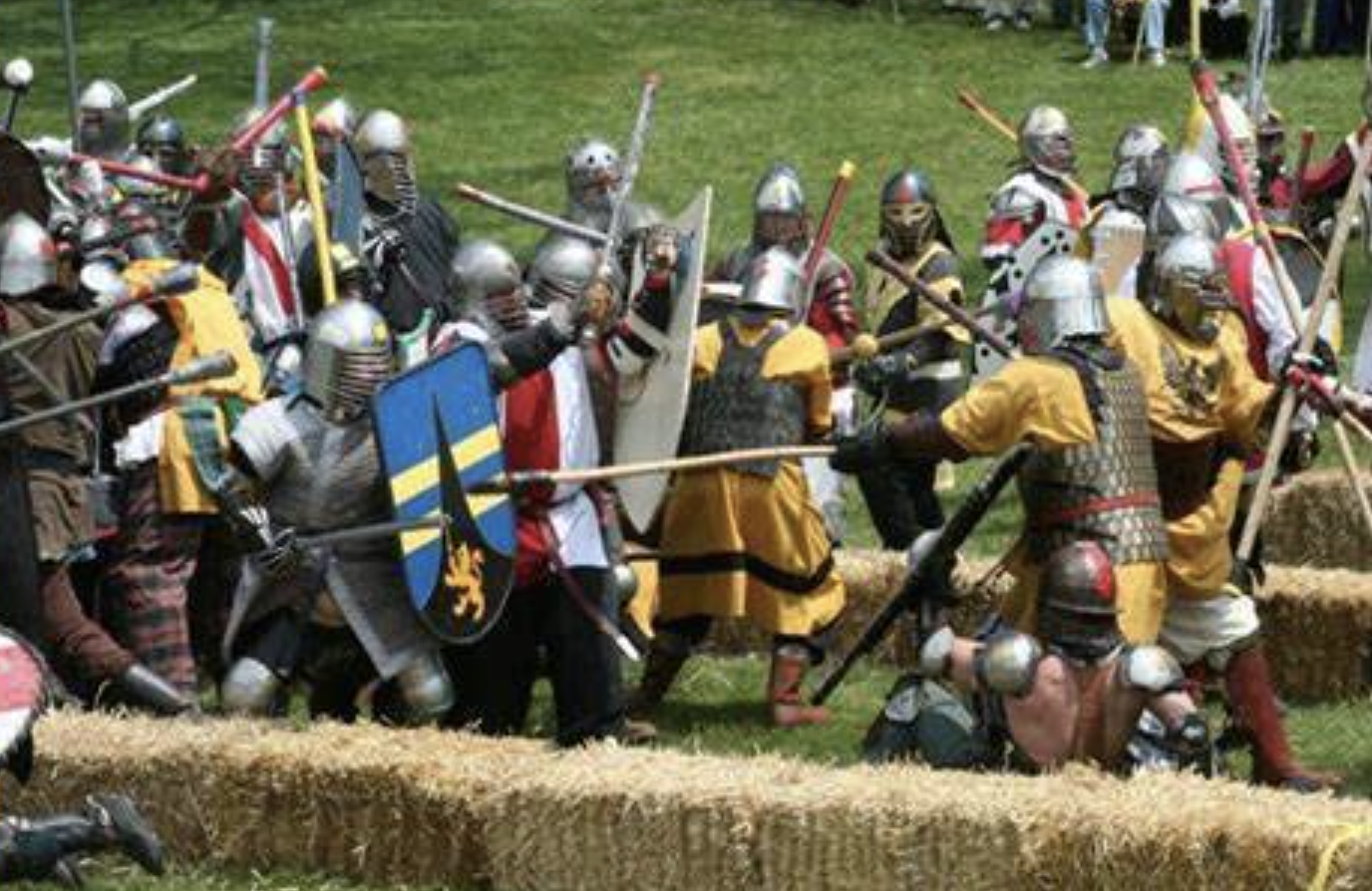
It has been generally argued that, since the 1960s, there have been a growing number of communities that celebrate—even live (if only for a short time)—medieval lifestyles. However, the Southern American slave owner used the practices of feudalism as an argument to justify slavery and the general way of life in the South, and that attitude continues to exist among some communities in the United States today. However, as Amy S. Kaufman argues, “although the symbols embraced by the far right may seem medieval—from Ku Klux Klan titles like “Grand Dragon” to the pseudo-medieval shields carried by “alt-righters”—their version of the Middle Ages is often filtered through contemporary medievalism in film, television, fantasy fiction, and video games.” It’s not all bad. Well, maybe it’s a little bit tacky-good:
Saturday Night Live — Medieval Times
To most of us, the Middle Ages of Europe are a foreign world. The space-time contiuum prevents us from fully “knowing” medieval life, and this fact emphasizes the fact of just how little we know each other in any place and time. Consider the movie, The 13th Warrior (1999), which is actually an adaptation of Michael Crichton’s novel, Eaters of the Dead, which is actually an appropriation of Beowulf.
The 13th Warrior (1999) | Official Movie Trailer
In the afterword of Eaters of the Dead, Crichton explains that a good friend of his was giving a lecture on the “Bores of Literature” that included an argument on why Beowulf was simply uninteresting. Those are fighting words! Crichton argued with his friend until it escalated into a fight and Crichton declared that he would prove to his friend that the story of Beowulf could be interesting if presented in the correct way. I’m not sure he succeeded with his “proof” since Beowulf the character never appears in Eaters of the Dead. This is why I state that Eaters of the Dead is not as much an adaptation of Beowulf as it is an appropriation. However, it certainly is a nice novel, and the movie adaptation is really good, too.
What does this have to do with medievalism and communities, you might ask? One of the interesting things about Eaters of the Dead is that it blends communities of the Middle Ages—actually, it juxtaposes the beliefs, values, knowledge, and wisdom of one region with another. Both the book and the movie represent a contact zone between Arabs and Norsemen (Vikings, Northern Europeans). In so doing, Crichton may have celebrated medieval narratology, but he also furthered misinformation about the Vikings. For example, the novel and the movie emphasize just how unsanitary Vikings were.
This is a myth. Indeed, the Denmark Museum argues, “If we examine ‘the toilet bags’ of the Vikings we find beautiful patterned combs, ear picks and tweezers.”
In more recent years, there has developed a scholarly movement toward what has become known as global medievalism(s). In their recent collection of scholarly essays, Angela Jane Weisl and Robert Squillace observe that “medievalism — the expression or enactment of attitudes toward modernity through an imaginative reconstruction of a premodern past — both illuminates and is illuminated by the emergent field of Global Studies. I believe, and I am arguing in my book (forthcomign), that this kind of study couldn’t have developed without the development of and study of medievalist Massive Multiplayer Online Role Playing Games (MMORPG).
It all seems to tie by to J. R. R. Tolkien. Indeed, The Hobbit (1937) and The Lord of the Rings trilogy (1954-1955) had a major cultural impact upon American communities (among others). Indeed, even science communities were affected, as Pamela Clements and I wrote several years ago in our book chapter, “Neo-Tolkienism: Plays upon Playing with Tolkien’s Playing with Language“:
For example, many of the rooms in the computer lab at SAIL “were given whimsical names that fit into a Lord of the Rings them. Printers at the lab were even programmed with an optional “Elvish” font derived from the writing system listed by Tolkien in the appendices to the fantasy series” (Adams, “The Crowther and Woods ‘Colossal Cave Adventure’ Game”). Furthermore, Les Earnest recalls that the intense computer work, “. . . created a need for food at all hours of the day and night, accessible with minimal distraction,” and he writes: “Around 1972 we developed SAIL’s response to this need, a computer controlled vending machine which sold on credit. Called the Prancing Pony after an inn in Tolkien’s Lord of the Rings, it still operates in the Computer Science Department at Stanford, though both hardware and soft-ware have been updated” (Earnest 30). (p. 357)
Pam and I also argued that
to best appreciate concepts of “playing” and of “games” in computer game adaptations of Tolkien’s works, one really must understand the origins of the word “hacking.” In the 1960s, at MIT, there was student club called the Tech Model Railroad Club (TMRC), whose members (according to Steven L. Kent) “had their own language. They called broken equipment munged. They called rolling chairs bunkies. They called garbage cruft. And they called practical jokes and impressive feats hacks” (16). In fact, the first interactive computer videogame (Steve “Slug” Russell’s Spacewar) was a gimmick, an impressive joke, a hack—one of many to come. (p. 353)
Indeed, there is something very medieval-sci/fi about video games, each of which — like all video games — are built upon a matrix program of some kind.
According to The Oxford English Dictionary, the word matrix derives from the late medieval Latin word meaning “womb” or an environment for growth and development. To-day, according to The Oxford English Reference Dictionary, one of the meanings of matrix has become “a rectangular array of elements in rows and columns that is treated as a single entity” (a mathematical term) or “a grid-like array of inter-connected circuit elements” (a computer sciences term). So, the little joke that we see is that a video game is a kind of womb into which the primary materials/code is planted/programmed to create an illusionary world into which a gamer might escape. Furthermore, it might be interesting to note that Windows-based PC engineers refer to the main board of a CPU as the “mother board”—clearly alluding to this medieval definition of matrix (even if only by coincidence)—while engineers of Apple computers prefer to use a more technical label, referring to their equivalent version as the “logic board.” (p. 355)
William Crowther was a well-respected computer programmer (graduating with a degree in physics from MIT in 1958)¹ who served as one of the few representatives of Bolt, Beranek, and Newman—the company the U.S. government contracted in the 1960s to develop and maintain the Advanced Research Project Agency Network (ARPANet, the forerunner to the Internet). Once ARPANet was up and running, while creating ever more efficient and effective code to help maintain and improve it, Crowther found himself spending his spare time either exploring caves (especially Mammoth Cave in Kentucky) or playing the paper and dice role-playing game, Dungeons and Dragons. In the early 1970s, missing his children (because of a recent divorce), Crowther decided to create a computer- text game for them; he once explained: “My idea was that it would be a computer game that would not be intimidating to non-computer people, and that was one of the reasons why I made it so that the player directs the game with natural language input, instead of more standardized commands. My kids thought it was a lot of fun” (Rick Adams).² The game, written in FORTRAN, was inspired by Crowther’s cave explorations and by his role-playing of “Willie the Thief” in Dungeons and Dragons. The program provided a text description of each scene and situation (no graphics, at first) to the player, who then typed in a command for the next move. Through this text-based communication, players explored caves, discovering monsters and treasures. The game program rapidly spread from one mainframe computer to the next. “Often someone would install Adventure in the wee hours of the night—without mentioning it to the computer staff—and move on, resulting in a mysterious yet impressive game program seeming to appear as if by magic” (Adams). (pp. 355-6)
In 1976, Don Woods discovered that someone had left a copy of Crowther’s game on one of the computers at the Stanford Artificial Intelligence Lab (SAIL, Stanford University), where he worked. With Crowther’s permission, Woods expanded the program by adding a troll, elves, and a volcano that reminds one of Tolkien’s Mount Doom. While Woods, himself, says the game “was written with no particular vision in mind” (Cordella),³ it is clear that he was in an environment laced with Tolkienesque references. (p. 356)
It has become equally clear, however, that while Tolkien might have been at least a large inspiration for all sorts of contemporary medievalist communities, including gaming communities (both online and tabletop), such community medievalism has gone way beyond that.
NOTES for the above:
¹ Yet, he was notorious for attending formal meetings at the Pentagon in sneakers.
² The game was also known as Colossal Cave and Colossal Cave Adventure; the original date of the game’s creation is uncertain, but it is generally believed to have been developed after 1972 (the year William Crowther’s divorce was finalized) and before 1976 (when the revised version made with Donald Woods was released). To see samples of the various versions of this game, visit Baf’s Guide to the IF Archive (http://www.wurb.com/if/game/1).
³ Rick Adams has since removed his observation about the rooms and the printer, but in an email he confirmed, “It wasn’t incorrect . . . just not really pertinent, as Don Woods has asserted that The Lord of the Rings really had no influence over his additions to the game” (Rick Adams. “Email: 7/16/08”).
Readily Available Materials
See Also:
Gender, Sexuality, Medieval Studies, and Medievalism
- VIDEO: Gender Identity and Sexuality in the Medieval World (Amy Kaufmann and Paul Sturtevant, June 9, 2021)
- VIDEO: Gender, Transgender and the Middle Ages (Alicia Spencer-Hall and Blake Gutt, December 7, 2023)
- Men and Women as Represented in Medieval Literature and Society (Anita Ka O’Pry-Reynolds, 2013)
- Women, Gender, and Medieval Historians (by Judith M. Bennett and Ruth
 Mazo Karras, 2013)
 - Gender and Status in the Medieval World (by Katherine Weikert and Elena Woodacre, 2016)
- “In their reckless lust they forget their sex” – LGBT history in the Middle Ages (by Tim Wingard, February 18, 2016)
- The Overlooked Queer History of Medieval Christianity (Roland Betancourt, October 7, 2020)
- Premodern Pedagogies: Queer Medieval Materiality (by Hilary Rhodes, 2021)
- Gender, Adaptation, and the Future in David Lowery’s The Green Knight (by Usha Vishnuvajjala, May 3, 2022)
- The Green Knight is the Existential Queer Folk Horror We Need (by Jude Ellison S. Doyle, August 9, 2021)
- Using Video Games to Confront Racism and Sexism (by Shefali O’Hara, October 11, 2021)
- Capital One’s Condemnation, Conversion, and Eventual Celebration of Mythical Medieval Northern European Males through Allegorical Commercials (by Carol L. Robinson, 2024)
- Any work(s) listed in Internet Medieval Sourcebook Selected Sources: Sex and Gender (1996-2024)
- Any work(s) listed in Gender, Sexism, and the Middle Ages (The Public Medievalist, 2018)
Dr. Amy Kaufman on Medievalism and Masculinity
Other Randomly Selected Materials
- The Alt-Right and Medieval Religions
- Inventing nostalgia for the “Golden Age” of the national Middle Ages and fear of the future: Nationalism, memory and phobias of medievalism and futurism in Japanese mass culture. (Maksym W. Kyrchanoff)
- The Influence of Saint Jerome on Medieval Attitudes to Women (Jane Barr)
- The Vikings as Explorers and Settlers
- The Vikings: A Memorable Visit to America
- Imagining Boccaccio as a Psuedo-feminist (Carol L. Robinson)
- French Women and Feminists in History: A Resources Guide—Witch Trials & Witchcraft
- Witches in History
- American Experience: The Roman Catholic Church in Medieval Europe
- The Ohio University Medieval Society
- Ohio Renaissance Festival — Notice that it is called a “Renaissance” festival, not a medieval festival, yet many confuse the two terms and that’s probably because there was much medievalism in England’s Renaissance.
- Medievalist Massive Multiplayer Online Role Playing Games (MMORPGs)
- Dungeons and Dragons Online
- The Lord of the Rings Online
- World of Warcraft
- Across the Obelisk (for PC) Review
- Baldur’s Gate 3 Review
- Crisis Core: Final Fantasy VII Reunion (for PC) Review
- Dark Souls II (for PC) Review
- Dark Souls III (for PC) Review
- Diablo III Review
- Diablo IV Review
- Dragon’s Dogma: Dark Arisen (for PC) Review
- Dragon’s Dogma 2 Review
- Elden Ring (for PC) Review
- The Elder Scrolls V: Skyrim Special Edition (for PC) Review
- Final Fantasy VII Remake Intergrade (for PC) Review
- Final Fantasy X/X-2 HD Remaster (for PC) Review
- Genshin Impact (for PC) Review
- Hades (for PC) Review
- Hogwarts Legacy Review
- Honkai: Star Rail Review
- MORE Games Reviewed
- Nordic Larp Wiki Live Action Role-playing Games (LARP)
- Society for Creative Anachronism
Find It in Your University Library
- Historical pageants and the medieval past in twentieth-century England. By: Angela Bartie, et. al. The English Historical Review. August 2018, Vol. 133, Issue 563, pp. 866-902.
Not Authentically Medieval
- Medieval cultures and modern crises: Agamben’s troubadours, angels and monks. by Luke Sunderland. Angelaki. Oct-Dec 2018, Vol. 23, Issue 5-6, pp. 77-93.
- ‘A nuisance to the community’: policing the vagrant woman. By: Julie Kimber. Journal of Australian Studies. Sep 2010, Vol. 34, Issue 3, pp. 275-293.
- Fictional and fictionalised religions as heritage? Reflections on the object of critical heritage studies. By: Mathilde van Dijk. International Journal of Heritage Studies. July 2023, Vol. 29, Issue 7, pp. 664-677.
- What does the Middle Ages teach us for today? By: Dominique Poirel. Annals of Cultural Studies/Roczniki Kulturoznawcze. 2020, Vol. 11, Issue 4, pp. 7-19.
- Popular genres and the Australian literary community: The case of fantasy fiction. By: K. Wilkins. Journal of Australian Studies. 2008, Vol. 32, Issue 2, pp. 265-278.
- Medieval Community: Lessons from the Film Black Knight. By: K. A. Laity. LATCH: A Journal for the Study of the Literary Artifact in Theory, Culture, or History. 2008, pp. 147-157.
- Editors’ introduction: Chaucer’s global orbits and global communities. By: Candace Barrington and Jonathan Hsy. Literature Compass. Jun 2018, Vol. 15, Issue 6.
- Hidden in plain sight: religion and medievalism in the British women’s suffrage movement. By: Carolyn P. Collette. Religion & Literature. Oct 2012, Vol. 44, Issue 3, pp. 169-175.
- Miraculous images and the sanctification of urban neighborhood in post-medieval Italy. By: Jane Garnett and Gervase Rosser. Journal of Urban History. July 2008, Vol. 32, Issue 5, pp. 729-740.
- Gay Internet medievalism: Erotic story archives, the Middle Ages, and contemporary gay identity. By: Steven F. Kruger. American Literary History. Winter 2010. Vol. 22, Issue 4, pp. 913-944.
- Future/s Medieval: Perspectives from the Anzamems community.
- White Nationalist identification with Old English exile: Or, why Old English poems matter. By: Maggie Hawkins. Literature Compass. Dec 2024, Vol. 21, Issue 10-12, pp. 1-8.
- Folk and fairy tales as philosophy through fantasy: An interpretation of memory, imagination, and culture. By: Riccardo Magini. Sofia Philosophical Review. 2023. Vol. 16, Issue 2, p. 92-114.
- Neomedievalist feminist dystopia. By: Daniel Lukes. Postmedieval: A journal of medieval cultural studies. Spring 2014, Vol. 5, Issue 1, pp. 44-56.
Not Authentically Medieval