by Carol L. Robinson
Kent State University
Introduction
Amaury Guichon | Chocolate D&D Dragon
I am using the term “arts and crafts” in a very broad sense here: a work of art can be anything from a painting to a film; likewise, a craftwork can be anything from a table to a video game. So, perhaps it might be prudent to begin with a discussion of the differences between a work of art and a work of craft. This is a difficult line to draw, and I want to emphasis that these are my definitions, my opinion, not to be held as factual. You will have to decide for yourself what is truly art and what is truly craft.
A craft work requires skill and experience. Many crafts, such as embroidery and glass blowing, call for many years of experience and skill before one is considered to be a master of the craft. If one wishes to become a craftsman today, according to ZipRecruiter:
Qualifications to become a craftsman include a high school diploma or equivalent and completion of a certificate program or an associate degree from a vocational school or community college. These trade programs provide the skills and experience you need to begin training. You may also choose to apprentice with a professional in your field of interest. Working in construction requires an understanding of building codes. Once you have finished your training, seek craftsman positions in your area, or you may choose to be an independent contractor and find your own clients.
Contemporary professional crafts include such jobs as: carpentry, plumbing, photography,
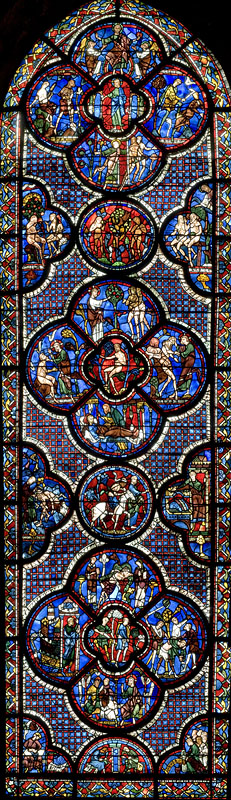
The Good Samaritan Window from Chartres Cathedral in France (Created 12th to 15th century)
videography, cooking/baking, electrical work, programming, and farming. A craft is generally associated with a trade. However, there are also hobby crafts, such as: weaving, knitting, gardening, ceramics, and carpentry. Any trade can easily be a hobby, and vise versa; however, many hobbies are no longer trades because there is no real need for such skills today.
During the European Middle Ages, many crafts were tied to guilds. Some examples of medieval crafts include: carpentry, masonry, building, weaving, cloth-making, embroidery, dyeing, tailoring, shoemaking, and making hats, selling food (baking and cooking), goldsmithing, silversmithing, other metalwork, armoring, sword making, painting, illuminating manuscripts, staining glass, mosaics, candle making, basket weaving, parchment making, and glassmaking.
A craft can certainly become a work of art. A work of art is a work that expresses a unique feeling and/or thought. A work of art is the application of a craft skill with the purpose of creatively expressing the self. People can make a living from their art, but it is not common.
Art of the European Middle Ages has a distinct style from contemporary art. Some characteristics of medieval art include: abstract forms, iconography, religious subject matter, elaborate patterns, bright colors, the use of precious metals and gems.
There have been periods when the arts and crafts of the European Middle Ages were celebrate, generally known as “medieval revivals”.
A List of Possible Arts & Crafts Topics
- Art
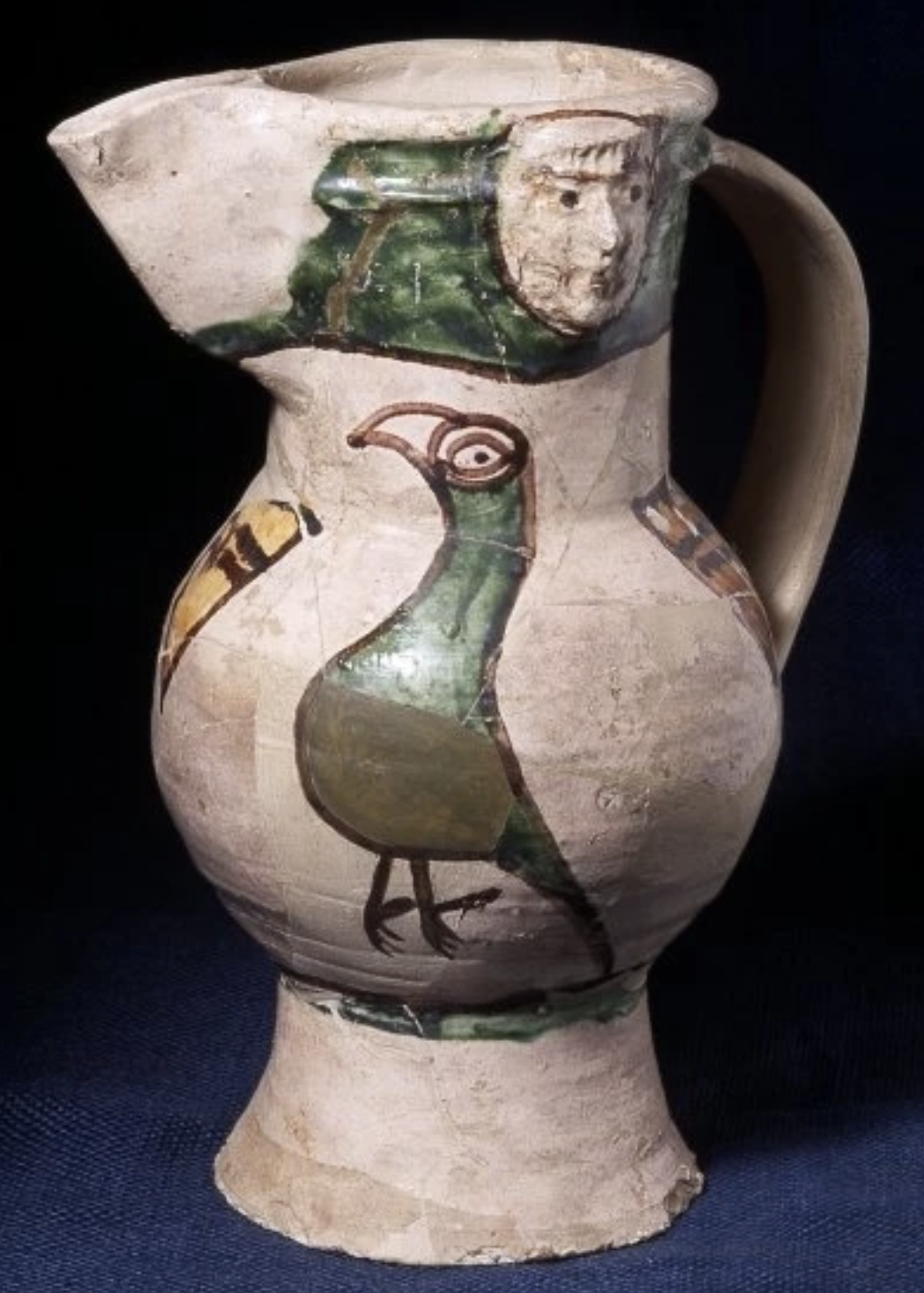
Elaborately decorated vessel found in Cardiff, Wales.
- Architecture
- Literature & Storytelling
- Medieval Literature & Storytelling (Wikipedia)
- More focused upon social roles, social behaviors
- Religion plays a major role
- Death is just the next step; the afterlife (Otherworld, Valhalla, Heaven/Hell, …)
- Types of Literature
- Romance
- Chivalric
- Arthurian (Chivalric stories set within Arthurian legends)
- Ancient (Chivalric stories set in Ancient Greece or Rome)
- Adventure
- Allegory
- Heroic Poetry
- The Lay
- Fabliau
- Alliterative verse
- Romance
- Postmedieval Literature & Storytelling
- Increased focus upon the inner person
- Humanism becomes an increasing influence
- Death is the end, permanence
- Medieval Fantasy vs. Historical Medieval Fantasy

The Princess Bride is a fairy tale. Fairy tales contain elements of the medieval, and some believe that they even have medieval origins, but most fairy tales were not written down until the 17th century, or later. The Princess Bride is a parody of fairy tales in many ways, full of spoofs. For example: the pirate is a product of post-medieval colonization efforts.
- Fairy Tales (postmedieval) vs. Medieval Romance
- Medievalism vs. Medieval Fantasy (postmedieval), Fairy Tales (post, and Medieval Romance
- Joan of Arc
- Norse Legends
- Robin Hood
- Arthurian Legends
- J. R. R. Tolkien
- Medieval Literature & Storytelling (Wikipedia)
- Film
- Television
- Games
- Music
- Textiles
- Food
Readily Available Materials
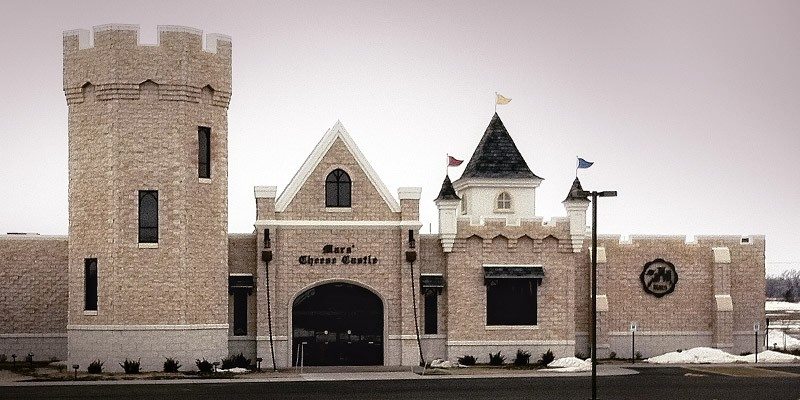
Mars Cheese Castle (Kenosha, Wisconsin) DOES NOT craft Medieval Cheeses!
-
- A List of Medieval Cheeses — House Capuchin
- Making 50 Medieval Cheeses (Kimetha Loidolt, New England Cheese Making Supply Company)
- Medieval Recipes
- Medieval Recipes
- Medieval Weaving Techniques Brought To Life with Little Looms
- Medieval Basket Weaving
The coolest class you’ll probably never take - Recordings of Medieval Music (e.g., modern digital productions)
- Bear Family Records: Medieval Music —Echoes of the Past
- William Morris Archive: Morris and Medievalism
- The Medieval Revival (Victorian)
- The Medieval Revival of the 1960s and 1970s
- Medieval revival: Scotland’s fashion and history reign supreme (21st Century)
- Write Your Name in Runes
- Ðæt Gettysburg Gemathel of Abraham Lincoln (The Gettysburg Address in Old English)
Videos on Medievalism in Craft and Fashion
Making a Medieval Manuscript
How to Make Illuminated Manuscripts
Medieval Brocaded Tablet Weaving: How to Add Sparkle to Your Narrowwork
Explaining the 1960s Folk Revival in Fashion and Music
Why the Medieval Aesthetic Never Dies: the History of Medieval Revival Fashion
A Medieval Fashion Revival in 2025? A Deep Dive Analysis!
BLANTON CURATED CONVERSATIONS – Mad About Medieval!
Sample List of Videos on Medievalism
in Music, Movies, and Television
- Best Medieval Movies of All Time (IMDb)
- Films Set in the Middle Ages (Wikipedia)
- Top 50 Medieval Movies You Need to Watch!
- The Ahistoricism of Medieval Film (Medievalists.net)
- Films Archive (Medievalists.net)
- My thoughts on — medieval movies (The Wandering Medievalist)
Creep (Bardcore | Medieval Style with Vocals)
dArtagnan – Wallenstein
Viking Kittens (Reupload) | Led Zeppelin “Immigrant Song”
A Knight’s Tale (2001)
—A Dance from Gelderland Scene (David Bowie, “Golden Years”)
Star Trek: Next Generation | “I am NOT a merry man!”
Monty Python and the Holy Grail (1974) Official Trailer
Henry V (1989) (film adaptation of Shakespeare’s play): “St. Crispin’s Day”
The Lion in Winter (1968) Official Trailer
The Great Wall (2016) | Official Trailer
The 13th Warrior (1999) | Official Trailer
The Messenger: The Story of Joan of Arc (1999) | Entire Movie
Tristan & Isolde (2006) | Official Trailer
Beowulf and Grendel (2005) | Trailer
TBS: Lord of the Rings Promotion—Secret Lovers
Find It in Your University Library
Works located in Journals and Periodicals: This list is neither organized nor at all comprehensive! Sorry!
- Otherworldly but not the Otherworld: Tolkien’s adaptation of medieval faerie and fairies into a sub-creative elvendom. By: Elliott Thomas Collins. Mythlore, Vol. 42, Issue 1, Fall-Winter 2023, pp. 107-119.
- Eric fighting in Guatemala: Adaptation and proximation of medieval Arthurian literature in Manuel Vázquez Montalbán’s Erec y Enide. By: Carlos Sanz Mingo. Journal of the International Arthurian Society, 2023, 11, pp. 83-104.
- The Catholic imaginations of J.R.R. Tolkien and Oscar Wilde. By: Frazier Alexander Johnson. Mythlore. Vol. 43, Issue 1, Fall-Winter 2024, pp. 19-39.
- Plato, C.S. Lewis, and J.R.R. Tolkien using literary and philosophical texts to navigate post-pandemic and political teaching challenges. By: Anne-Marie Schultz and C.D. Maples. Religions. Vol. 15, Issue 3, Mar 2024, pp. 1-11.
- Grotesque as aesthetic identity: From medieval illumination to contemporary art. By: Mircea-loan Lupu. EIRP Proceedings. Vol. 8, Issue 1, 2013. pp. 263-278.
- Between real and phantasy: Encouraging creativity in the first year architectural education through fairy tales. By: Lerzan Aras. International Journal of Art & Design Education. 2024. Vol. 43, Issue 2, pp. 205-220.