
by Carol L. Robinson
Kent State University
Table of Contents
- A Brief Review of Medieval European Concepts
- Introduction
- Feudalism
- Antifeminism
- Mysticism
- Chivalry
- Medieval Germanic Warrior Code
- The Art of Courtly Love
- The Medieval University
- Medieval Tropes
- Understanding Medievalism(s)
- Readily Available Materials
- Find It at Your University Library
A Brief Review of
European Medieval Concepts
Introduction
The Middle Ages Explained in 10 Minutes
Six Myths about the Middle Ages
Medieval Europe Was Peaceful, Diverse and Wasn’t White
The European Middle Ages existed after the fall of the Western Roman Empire and before the Renaissance, approximately from the mid-5th to the late 15th centuries—although, in some parts of Europe it lasted later. This period tends to be understood in three parts:
- the Early Middle Ages: roughly, the mid-5th century to the 10th century (400s to 900s, CE)
- the High Middle Ages: roughly, the 11th century to the 14th century (1000s to 1300s, CE)
- the Late Middle Ages: roughly, the 14th century to the end of the 15th century (1300s to 1500s, CE)
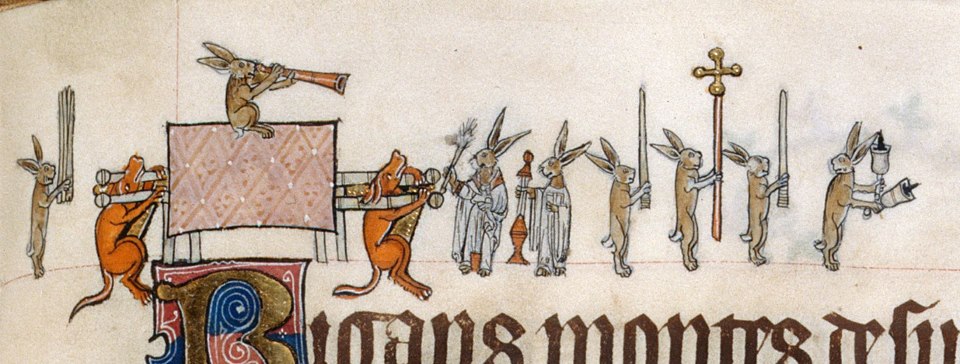
Rabbits, owls, cats, dogs, mice, monkeys, snails, and other animals were common in medieval manuscript illustrations.
The year 1500 tends to be considered the end of the Middle Ages, although some parts of Europe entered the Renaissance period much earlier. 19th century historians tended to refer to the Middle Ages as the “Dark Ages” because, after the fall of the Roman Empire, political and religious chaos ensued. By comparison, the Renaissance (which means “rebirth”) was a period of reawakening of scientific and artistic exploration, a renewed interest in classical Greek and Roman learning. There was an explosion of artistic, scientific, creative, logical thought, and exploration. The Renaissance marks a time of exploration, conquest (the practice of taking control of a government by another country, usually by military force) and/or colonialism (the practice of one country or group exploiting the people and resources of another country for an indefinite period of time). By comparison, the Middle Ages were a “quieter” time, a time of “rest”. This does not at all mean that there wasn’t intellectual and creative growth during the Middle Ages—for example, the university is an institution originated from the Middle Ages.
Basics of Medieval Philosophy
Feudalism
The dominant social system in medieval Europe, in which the nobility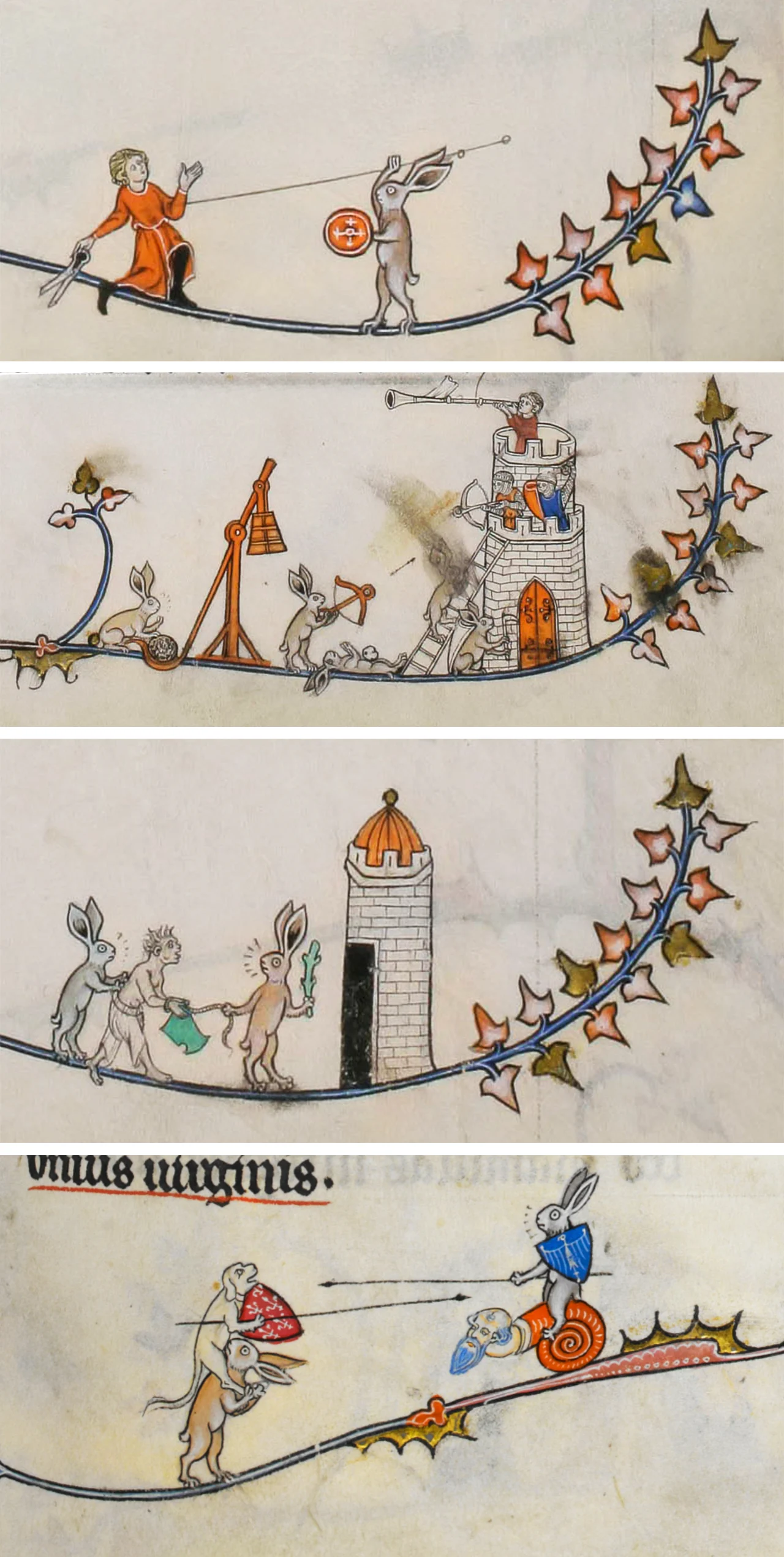 held lands from the crown (typically, a king) in exchange for military service, and vassals were in turn tenants of the nobles, while the peasants (villeins or serfs) were obliged to live on their lord’s land and give him homage, labor, and a share of the produce, notionally in exchange for military protection.
Antifeminism
The belief that women are not equal to men, that women are a lesser “other” to men. The writings of St. Jerome both reflected and influence medieval attitudes toward women. St. Jerome (c. 342-347 CE) is perhaps best known for his translation of the Bible into Latin, a text that became known as the Vulgate. In about 389 CE, he established a monastery in what was then Bethlehem, Paletine. His writings greatly influenced values and thoughts held in the European Middle Ages. He is considered to be the patron saint of librarians, translators, scholars, archaeologists, and encyclopedists.
Mysticism
Christian mystics were important during the European Middle Ages; a mystic was considered to be special—holy, wise, elite. Mystical experiences were considered to be a unique, yet secret, means of becoming closer to God, bringing about greater religious knowledge and spirituality. The term “mysticism” is derived from an ancient Greek word (múō), meaning “to conceal” or “to close”.
Chivalry
This is a religious, moral, and social code of behavior for medieval knights.
- oaths of loyalty (in this order) to:
- God
- King
- Fair Lady
- the importance of
- faith
- hope
- charity
- justice
- wisdom
- honesty
- courtesy
- humility
- valor
- generosity
- always protect the weak
- rescue damsels in distress
- never resist fighting all dragons, evil men, giants, and other monsters
Medieval Germanic Warrior Code
(Anglo-Saxon Heroic Code)
-
- stoicism, strength, bravery, honor, loyalty, honesty, selflessness, generosity, pride (confidence), fame and glory
- a retainer (warrior) holds loyalty to the king (defend to the death)
- the king is protected by a body of retainers (most likely family)
- the custom of gift-giving and the king as “ring-giver”
- blood vengeance: a warrior must seek compensation for the death or injury of a kinsman, either through the death of another or with weargild (blood money)
- the importance of living forever in story/history with fame and glory
- the horror of living forever in story/history in shame
- a boast is not at all a bad thing, if it can be supported
- a respect for Wyrd (goddess of fate), and later for God
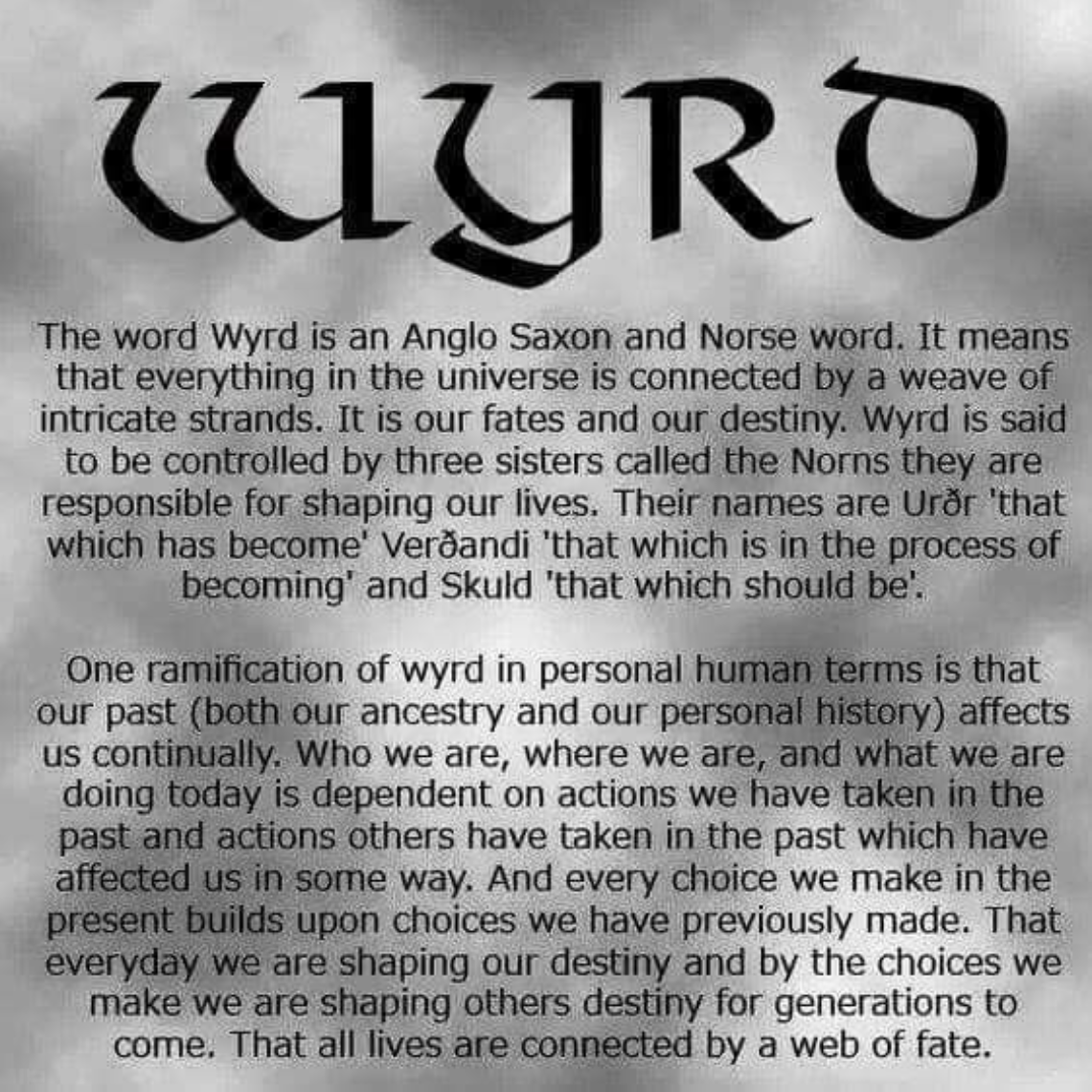
Wyrd is weird!
Andreas Capellanus
The Art of Courtly Love (c.a. 1170s)
(This is very secular–the Church did not approve of most of these rules!)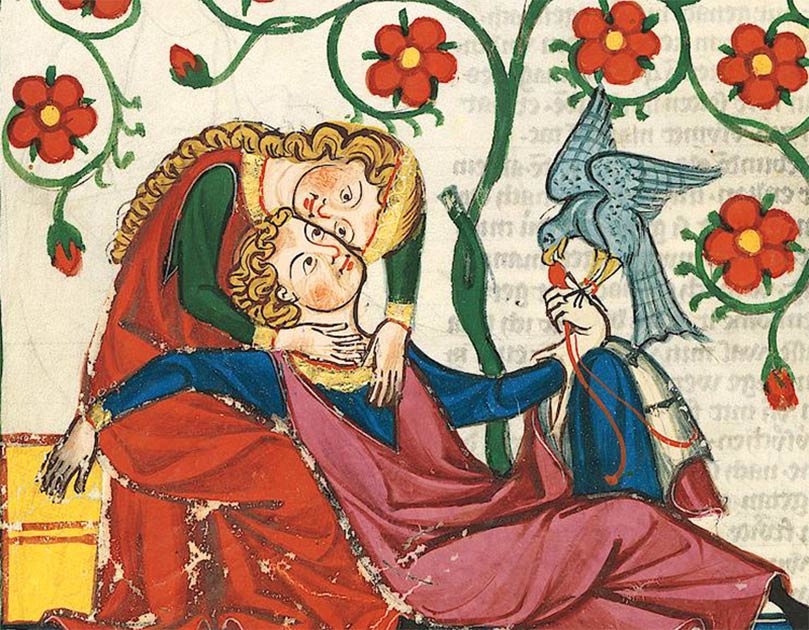
- Marriage is no real excuse for not loving.
- He who is not jealous cannot love.
- No one can be bound by a double love.
- It is well known that love is always increasing or decreasing.
- That which a lover takes against his will of his beloved has no relish.
- Boys do not love until they arrive at the age of maturity.
- When one lover dies, a widowhood of two years is required of the survivor.
- No one should be deprived of love without the very best of reasons.
- No one can love unless he is impelled by the persuasion of love.
- Love is always a stranger in the home of avarice.
- It is not proper to love any woman whom one should be ashamed to seek to marry.
- A true lover does not desire to embrace in love anyone except his beloved.
- When made public love rarely endures.
- The easy attainment of love makes it of little value; difficulty of attainment makes it prized.
- Every lover regularly turns pale in the presence of his beloved.
- When a lover suddenly catches sight of his beloved his heart palpitates.
- A new love puts to flight an old one.
- Good character alone makes any man worthy of love.
- If love diminishes, it quickly fails and rarely revives.
- A man in love is always apprehensive.
- Real jealousy always increases the feeling of love.
- Jealousy, and therefore love, are increased when one suspects his beloved.
- He whom the thought of love vexes, eats and sleeps very little.
- Every act of a lover ends with in the thought of his beloved.
- A true lover considers nothing good except what he thinks will please his beloved.
- Love can deny nothing to love.
- A lover can never have enough of the solaces of his beloved.
- A slight presumption causes a lover to suspect his beloved.
- A man who is vexed by too much passion usually does not love.
- A true lover is constantly and without intermission possessed by the thought of his beloved.
- Nothing forbids one woman being loved by two men or one man by two women.
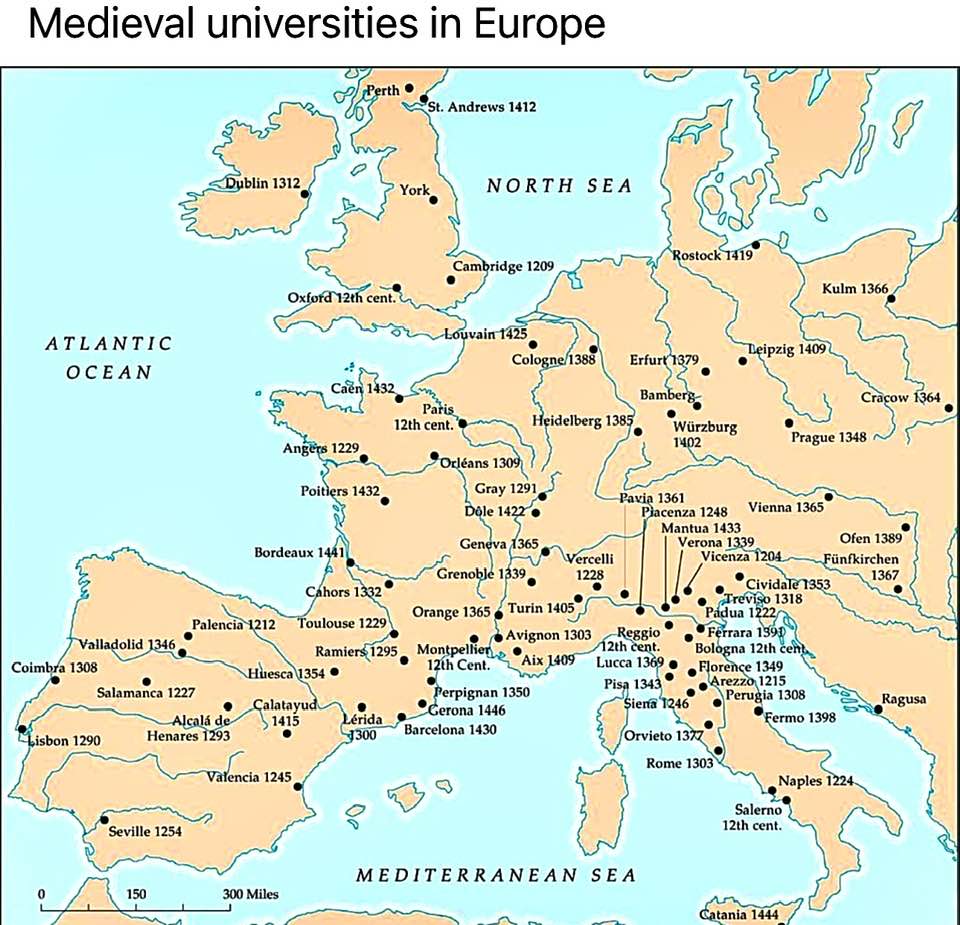
The Medieval University
The first universities in Europe were established by Christian monks. The University of Bologna (Università di Bologna), Italy, which was founded in 1088, is generally considered to be the first university. While contemporary universities and colleges are different, today, they are still—on a fundamental level—medieval in mission and vision.
Medieval Tropes
A trope is a figurative use of a word or image. It can also be a theme (an dominating idea or feeling) or a motif (something that repeatedly appears). A medieval trope is a figurative word or image that represents or alludes to the European Middle Ages. Some medieval tropes associated with the Middle Ages include:
- Stained glass windows
- Swords, shields, axes, spears, and body armor—all of these military tools existed prior to the Middle Ages, but medieval designs were uniquely different from earlier designs.
- Medieval clothing—below are some images of what is often considered to be “authentic” medieval clothing; some of it is, some of it isn’t authentic:

- Monasteries
- Plagues
- Food
- Nobility
- Universities: the university is a medieval construction.
- Castles and similar architecture

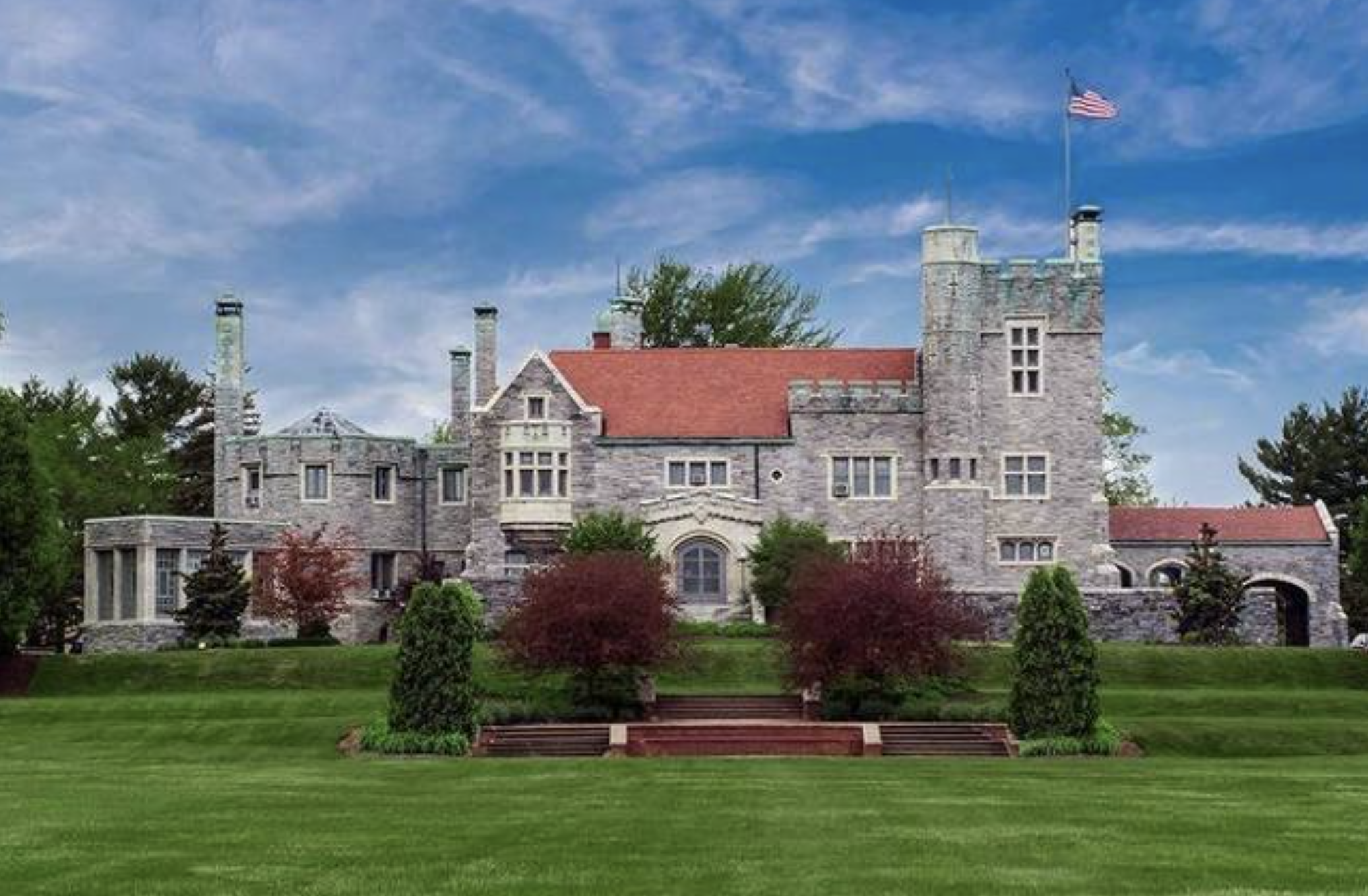
Glamorgan Castle (Alliance, Ohio) was built by Col. William Henry Morgan, an immigrant from Wales. Col. Morgan was the president and principal owner of The Morgan Engineering Company which was founded by his father, Thomas Rees Morgan. This castle was built in in Alliance, Ohio, in 1904: Col. Morgan was a man of unusual and varied talents—an electrical engineer, inventor, and a lover of literature, art and music. He was also known as a man who rarely did anything on a small scale! Glamorgan Castle is the original design of architect Willard Hirsh. Hirsh combined the style of the medieval baronial castle with the most scientific and practical aids of early twentieth-century life. Ohio has several castles. Anyone up for a field trip?

This is Fort Mountain State Park (Chatsworth, Georgia); you’re looking at a fire tower that was built by the CCC in the 1930s. Fort Mountain State Park derives its name from an ancient stone rock edifice situated near the crest of the mountain that was constructed between 500 – 1500 CE. According to Cherokee lore, the wall was built by the “Moon-eyed people” (light skinned people, who saw better during the night than the day, which suggests that they were northern Europeans). Georgia has several castles. Anyone up for a field trip?
Understanding Medievalism(s)
Medieval literature has inspired a great number of fantasy novels, films, music, theatre, video games, and live action role-playing (from Dungeon and Dragons to LARPs). The study of medievalism in this sense is the study of how medieval times continue to exist since the Middle Ages. What does it mean that so many people are so fascinated by the medieval?
The scholarly journal Studies in Medievalism was founded upon this interest by Leslie J. Workman and Kathleen Verduin, who also founded the International Society for the Study of Medievalism was founded (in the early 1980s), it was a scandal. Such studies were not considered to be true medieval studies. However, well established scholars in both Europe and North America pressed forward to demonstrate the validity of such studies. The Italian scholar/novelist Umberto Eco was among the first to publish analyses of medievalism in contemporary times, as was J. R. R. Tolkien and Old English literature scholar Tom Shippey. Since the 1970s, there has been a growing faction of medieval scholars who have asked deeper and deeper questions relevant to this topic. The scholarly journal Studies in Medievalism was one of the first publications to address this phenomenon, and it was  the first scholarly journal published in English. In 2010, another scholarly journal was started, postmedieval: a journal of medieval cultural studies—it serves as a more eclectic collection of thoughts about how we view medieval times. Because of this questioning, the canon of what we teach students—not to mention how we teach it—has changed. There seems to have developed a binary division between conservative medieval scholars (traditionalists) and liberal medieval scholars (the ones making all the questions). Social media has allowed these discussions to become more public—ranging from healthy debates to passionate fighting words (and even more hateful acts).

Look at the price! Look at the price! Look at the price! SOURCE: Ebay (2013)
Medievalism: The lines between Ancient Times, the Middle Ages, and Modern Times are fuzzy. In truth, there has never been a complete breach with medieval ideas and institutions. Medievalism is the remnants of medieval values and thought. Below are some basic definitions that I wrote for the (now defunct) Medieval Electronic Multimedia Organization:
Medievalism: “Medievalism is the study of responses to the Middle Ages at all periods since a sense of the mediaeval began to develop. Such responses include, but are not restricted to, the activities of scholars, historians and philologists in rediscovering medieval materials; the ways in which such materials were and are used by political groups intent on self-definition or self-legitimation; and artistic creations, whether literary, visual or musical, based on whatever has been or is thought to have been recovered from the medieval centuries. The Middle Ages remain present, moreover, in the modern consciousness, both through scholarship and through popular media such as film, video games, poster art, TV series and comic strips, and these media are also a legitimate object of study, if often intertwined with more traditionally scholarly topics.”
(Tom Shippey, Studies in Medievalism)
Modernist Medievalism:
Experimental contemporary “medievalist” narratives that contain stereotyped medieval characterizations and plots infused with an awareness, exploration and elevation of individual unconsciousness and consciousness: medieval romances, for example, with psychological depth. The values in such works are Modernist (full of angst and a sense of the futile) combated by an idealized “happy” and/or more “simple” life of the Middle Ages. They are fictions that imply historical discontinuity, rejecting traditional values and assumptions. Post-publication Revision: Experimental medievalist fictions that imply historical discontinuity, rejecting traditional values and assumptions; rewritten medieval values and assumptions into new values and assumptions, but framed within symbolic antiquities associated with the Middle Ages. Full of angst and a sense of futility, an infusion of what we perceive to be medieval characterization, plot, and fantasy with an awareness, exploration and elevation of the individual unconsciousness and consciousness. Such works may contain, for example, contemporary “medieval” narratives that contain stereotyped medieval characterizations and plots infused with an awareness, exploration and elevation of individual unconsciousness and consciousness: medieval romances, for example, with psychological depth.
Postmodern Medievalism: More “medieval” than Modern Medievalism in that they are contemporary “medieval” narratives that recognize an inability to understand the past any more than one can understand the future. Thus, they are more authentic to medieval values and assumptions in that they recognize the infiltration of modernist ideology and reject it. Fragments of a fragmented history, a synergism of histories, seamless and constantly changing histories that strike us as “medieval.” Post-publication Revision: More “medieval” than Modernist Medievalism in that it is more critical of contemporary perspectives of medieval values and societal codes, these narratives are overtly constructed and synergized fragments of a fragmented history, seamless and constantly changing in perceptions and interpretations of the medieval without idealizing these changes and perceptions. Thus, they are often less comprehensive: fragments of a fragmented history, a synergism of histories, seamless and constantly changing histories that strike us as “medieval”—whether or not they truly are medieval in nature. A recognition that we don’t really know the past any more than we know the future (much less the current zeitgeist). In other words, contemporary “medieval” narratives that recognize an inability to understand the past any more than one can understand the future. Because they are often self-reflexive, such narratives may be more authentic to medieval values and assumptions in that they recognize the infiltration of modernist ideology and reject it.
Neomedievalism: Involves contemporary “medieval” narratives that purport to merge (or even replace) reality as much as possible. There is no longer a sense of the futile and is thus more playful and in greater denial of reality. Neomedievalism engages alternative realities of the Middle Ages, generating the illusion into which one may escape or even interact with and control—be it through a movie or a video game. Already fragmented histories are purposed as further fragmented, destroyed and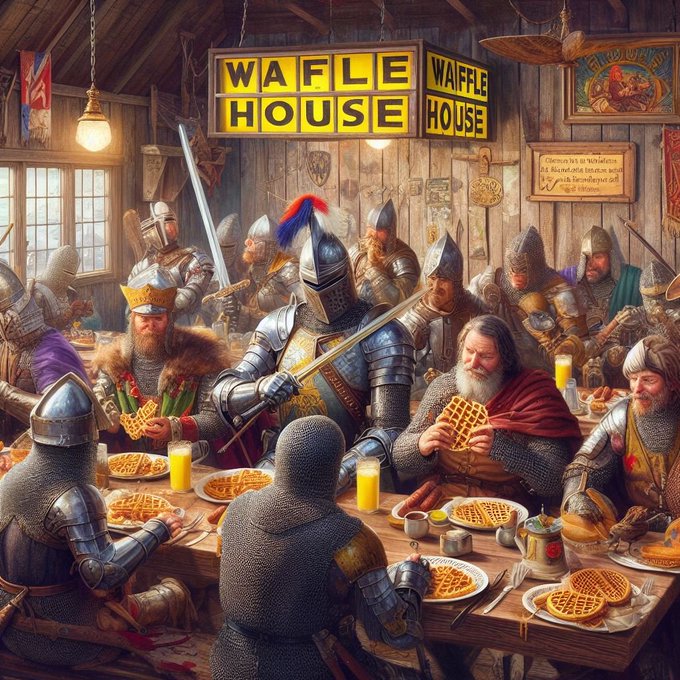 rebuilt to suit whimsical fancy, particularly in video games, where the illusion of control is most complete. Surrealism becomes less of a fantasy or nightmare and more of an illusion of reality that might even be controlled. The idea of the contemporary person existing in the Middle Ages, such as Mark Twain’s Sir Boss (A Connecticut Yankee in King Arthur’s Court) is no longer an absurdity, or rather, it is no less absurd than the idea of fantasizing and even reliving the Middle Ages. It is a seriously gleeful embrace of the absurd. Post-publication Revision: Neomedievalism is a neologism that was first popularized by Italian medievalist Umberto Eco in his 1973 essay “Dreaming in the Middle Ages,” (Travels in Hyper Reality) and has been used in a variety of ways since.¹ Angst becomes aggression. Histories are purposely fragmented. The illusion of control is made through changes of the illusion, rather than attempted changes of reality. There is no longer a sense of the futile, or at least it is second-staged by an illusionary sense of power and a denial of reality. Medieval concepts and values are purposely rewritten as a consious vision of an alternative universe (a fantasy of the medieval that is created with forethought). Furthermore, this vision lacks the nostalgia of earlier medievalisms in that it denies history. Contemporary values (feminism, gay rights, modern technolgical warfare tactics, democracy, capitalism, …) dominate and rewrite the traditional perceptions of the European Middle Ages, even infusing other medieval cultures, such as that of Japan. Neomedievalist stories are contemporary “medieval” narratives that purport to merge (or even replace) reality as much as possible; compared to postmodernist and modernist medievalisms, they are more playful and in greater denial of reality.
Medievalism(s) permeate American society. This might be because the United States has no authentic European medieval past and so cherishes it a bit more than European counties. Perhaps. As a part of its justification for slavery, leaders of the American South cited feudalism as better form of rule, and similar ideas continue to exist right up to today; as medical doctor Robert S. Kiefner argues, “Project 2025 has something for everyone who yearns for the bloodletting of the Middle Ages.”
Consider (and/or Reconsider)
- Transculturation: A process in which a subordinated group assimilates (takes in; transforms) cultural materials from the dominate group.
- Who was dominating whom (culturally)?
- The Warrior Heroic Code vs. The Chivalric Heroic Code vs. Today’s Heroic Code (whatever that is)
- The importance of establishing heroic lineage vs. the importance of generating historical context
- The Feudal System vs. the Capitalist System
- The medieval understanding of the cosmic order (the Earth is at the center) vs. contemporary understanding of the cosmic order (the sun is at the center)
- Consider the meaning of the word patient— how it has changed over the years
- Fiction vs. Fact (History vs. Story)
Return to Top
ML 103: Medievalism: The Basics
From Grimdark to Romantic: The Two Faces of Medievalism | Making History
What Is Medievalism? (Madeleine Rose Jones)
Readily Available Materials
UPDATED: January 13, 2025
This is by no means a comprehensive list, and I will continue to add to it for a few more weeks. Also, I have mixed sources for medieval studies in with sources for the study of medievalism because many of the former include the latter (and vise versa). Finally, I apologize for the lack of organization of this material.
A Few General Sources on the Middle Ages and Medievalism
- Regional Maps of the Middle Ages
- Medieval Digital Resources (Medieval Academy of America)
- Internet Medieval Sourcebook
- Chaucer MetaPage
- Harvard’s Chaucer Website
- CARMEN: The World Wide Medieval Network
- Medievalism (Wikipedia)
- The Camelot Project
- The One Ring Net (Tolkien Studies)
- Tales After Tolkien Society
Societies that Study (or have studied) Aspects of the Middle Ages and/or Medievalism
- International Society for the Study of Medievalism
- Babel Working Group
- Medieval Electronic Multimedia Organization
- Medievalists of Color
- International Arthurian Society—North American Branch
- TEAMS Medieval
- The Tolkien Society
- International Association of Robin Hood Studies
Other Societies, Non-Academic Organizations, and Companies
- Society for Creative Anachronism
- Midrealm Kingdom
USA: Michigan, Ohio, Indiana, Illinois, most of Kentucky, and some of Iowa (Scott County, eastern Muscatine County, most of Clinton County).
CANADA: Essex County and Windsor in Ontario. - Knights of Northeast Ohio: Mike Polk Jr. meets local immersive history group
- Midrealm Kingdom
- Medieval Times: Dinner and Tournament
- Excalibur Casino: Tournament of Kings
- King Arthur Baking Company
- Robin Hood Flour
Journals & Blogs on Medieval Studies and Medievalism
- Studies in Medievalism
- The Year’s Work in Medievalism
- Postmedieval
- In the Middle
- The Public Medievalist
- The Bulletin of the International Association for Robin Hood Studies
- Arthuriana
- The Once and Future Classroom
- Tolkien Studies: An Annual Scholarly Review
- Medievalists.Net
- Medievalists.Net YouTube Channel
- The Medieval Review
- The Medieval in Motion—Site I
- The Medieval in Motion—Site II
Randomly Organized Articles & Book Chapters
- Medievalism: Why It Matters In The Information Age
- Medievalism, Nationalism, and European Studies: New Approaches in Digital Pedagogy (Esther Liberman Cuenca)
- Illuminating Women in the World of Jerome. Policy and Practice Diverged
- Medievalism: Why It Matters in the Information Age (Madeleine Jones)
- Medieval Studies in Troubled Times: The 1930s (David Wallace)
- Has the Renaissance Warped Our View of the Middle Ages? (Kathleen McGarvey)
- The Medieval and the Fascist (Chase Padusniak)
- Teaching Medieval Chivalry in an Age of White Supremacy (Rachel Moss)
- A Vile Love Affair: Right Wing Nationalism and the Middle Ages (Andrew Elliott)
- Medieval Dreams and Far Right Nightmares (Benjamin Bertrand and Tirumular Narayanan)
- Deus Vult: Fantasies of Medieval Masculinity in Extreme Right Radicalisation to Violence (Rachel E. Moss)
- In search of lost elsewheres: Medievalism today (David Matthews, 2024)
- Medievalism: new discipline or scholarly no-man’s land? (by Richard A. Marsden, 2018)
Find It in the University Library
ebooks
- Medievalism: a manifesto. By: Richard J. Utz. Arc Humanities Press, 2017. (eBook available)
- Medievalism: a critical history. By: David Matthews. D.S. Brewer, 2015.
- Feminist medievalisms: embodiment and vulnerability in literature and film. By: Usha Vishnuvajjala. Arc Humanities Press, 2024.
- International medievalisms: from nationalism to activism. By: Mary Boyle. D.S. Brewer, 2023.
- Global medievalism: an introduction. By: Helen Young. Cambridge University Press, 2022.
- Medievalism and reception. Edited by: Ellie Crookes and Ika Willis. D.S. Brewer, 2024.
- Medievalisms and Russia: the contest for imaginary pasts. By: Eugene Smelyansky. Arc Humanities Press, 2024.
- Antiracist medievalisms: from “Yellow Peril” to Black Lives Matter. By: Jonathan Hsy. Arc Humanities Press, 2021.
- Erotic medievalisms: medieval pleasures empowering marginalized people. By: Elan Justice Pavlinich. Routledge, 2023.
- Affective medievalism: love, abjection and discontent. By: Thomas A. Prendergast and Stephanie Trigg. Manchester University Press, 2019.
- New Zealand medievalism: reframing the medieval. Edited by: Anna Czarnowus and Janet M. Wilson. Routledge, Taylor & Francis Group, 2024.
- Medievalisms in a global age. Edited by Angela Jane Weisl and Robert Squillace. D.S. Brewer, 2024.
- Old English medievalism: reception and recreation in the 20th and 21st centuries. Edited by Rachel A. Fletcher, Thijs Porck, and Oliver M. Traxel. D.S. Brewer, 2022.
- Medievalism in Finland and Russia: twentieth and twenty-first century aspects. Edited by: Reima Välimäki. Bloomsbury Academic, 2022.
- Subaltern medievalisms: medievalism ‘from below’ in nineteenth-century Britain. Edited by David Matthews and Mike Sanders. D.S. Brewer, 2021.
- World medievalism: the Middle Ages in modern textual culture. By: Louise D’Arcens. Oxford University Press, 2021.
- The Oxford handbook of music and medievalism. Edited by Stephen C. Meyer and Kirrsten Yri. Oxford University Press, 2020.
- Medievalism in English Canadian literature: from Richardson to Atwood. By: M.J. Toswell and Anna Czarnowus. D.S. Brewer, 2020.
- Speculative medievalisms: discography. Edited by the Petropunk Collective. Punctum Books, 2013.
- National medievalism in the twenty-first century: Switzerland and Britain. By: Matthias D. Berger. Boydell and Brewer, 2023.
- Medievalism: The Middle Ages in Modern England. By: Michael Alexander. Yale University Press, 2017.
- Memory and medievalism in George R. R. Martin and Game of Thrones: The keeper of all our memories. Edited by Anna Czarnowus and Carolyne Larrington. Bloomsbury Academic, 2022.
- Medievalism in A Song of Ice and Fire and Game of Thrones. By: Shiloh Carroll. Boydell & Brewer, 2018.
- Craft beer culture and modern medievalism: brewing dissent. By Noëlle Phillips. Amsterdam University Press, 2019.
- Children’s Literature and Old Norse medievalism. By David Clark. Arc Humanities Press, 2023.
eBook Volumes of Studies in Medievalism: Each of these works is readily available as eBooks online via KSU Libraries. However, it might be easiest to access these books online from an on-campus computer (such as in your campus library). I own several older volumes of Studies in Medievalism, so if there is a particular article you would like me to scan for you, just ask and I’ll see what I can do.
- Studies in Medievalism XXIV: Medievalism on the margins. Edited by Karl Fugelso with Vincent Ferré and Alicia C. Montoya. D.S. Brewer, 2015.
- Studies in Medievalism XXV: Medievalism and modernity. Edited by Karl Fugelso with Joshua Davis and Sarah Salih. D.S. Brewer, 2016.
- Studies in Medievalism XXVI: Ecomedievalism. Edited by Karl Fugelso with Joshua Davis and Sarah Salih. D.S. Brewer, 2017.
- Studies in Medievalism XXVII: Authenticity, medievalism, music. Edited by Karl Fugelso. D.S. Brewer, 2018.
- Studies in Medievalism XXVIII: Medievalism and discrimination. Edited by Karl Fugelso. D.S. Brewer, 2019.
- Studies in Medievalism XXIX: Politics and medievalism. Edited by Karl Fugelso. D.S. Brewer, 2020.
- Studies in Medievalism XXX: Politics and medievalism II. Edited by Karl Fugelso. D.S. Brewer, 2021.
- Studies in Medievalism XXXI: Politics and medievalism III. Edited by Karl Fugelso. D.S. Brewer, 2022.
- Studies in Medievalism XXXII: Medievalism in play. Edited by Karl Fugelso. D.S. Brewer, 2023.
- Studies in Medievalism XXXIII: (En)gendering medievalism. Edited by Karl Fugelso. D.S. Brewer, 2024.
Works located in Journals and Periodicals: These are not organized, but they all tie issues of medievalism. This list is not at all comprehensive! Each of these works is readily available online via KSU Libraries.
- Militarism in medievalism: the Prince of Thieves video game and the Gulf War. By: Tess Watterson. Rethinking History. Sep 2024, Vol. 28, Issue 3, pp. 376-398.
- The Medieval in the modern: Nazi and Italian Fascist use of the ritual murder charge. By: Kertzer, David I. and Gunnar Mokosch. Holocaust and Genocide Studies, Vol. 33, Issue 2, Nov 11, 2019, pp. 177-196. https://doi.org/10.1093/hgs/dcz023
- A new god for a new paganism: The Green Man in the modern pagan milieu. By: Ethan Doyle White. Journal for the Study of Religion, Nature and Culture. Vol. 17, Issue 2, 2023, pp. 201-227.
- Journey or destination?: Rethinking pilgrimage in the Western tradition. By: Anne E. Bailey. Religions. Vol. 14, Issue 9, Sep 2023, pp. 1-15.
- ‘Now you are Robin Hood: Prince of Thieves’: Intermedial medievalism. Tess Watterson. Adaptation. Mar 2023, Vol. 16, Issue 1, pp. 50-62.
- Of Bawns and Bros: Beowulf translations and a modernist medievalism. By Mikaela Renshaw. Essays in Medieval Studies. Vol. 36, 2022, pp. 1-20.
- “Authentic and what real Muslims wore”: Medieval textiles as a source of religious authenticity in contemporary knitting patterns. By: S.J. Pearce. Textile: The Journal of Cloth & Culture. Oct 2024, pp. 1-19.
- Global pasts and ‘Straits medievalism’ at the Asian Civilizations Museum. By: Louise D’Arcens. Parergon. Vol. 39, Issue 1, 2022, pp. 1-21.
- Unthought medievalism. By: Marisa Galvez. Neophilologus. Vol. 105, Issue 3, Sep 2021, pp. 365-389.
- Eugene Field, Wynkyn de Worde, medievalism, and authenticity. By: Thomas A. Bredehoft. Medieval Perspectives. 2022, Vol. 36, pp. 85-107.
- “Savage” and “medieval” in C.S. Lewis’s The Discarded Image. By: Thomas Klein. Neophilologus. Sep 2023, Vol. 107, Issue 3, pp. 521-536.
- Conspiritorial medievalism: History and hyperagency in the far-right Knights Templar security imaginary. By: K.M. Millar and J. Costa Lopez. Politics. November 2024, Vol. 44, Issue 4, pp. 588-604.

¹ Neomedievalism is perhaps the most varied in its definitions, and thus the most controversially contested. When Umberto Eco uses the term in the 1970s, for example, he really means the general definition of medievalism. When Medieval Electronic Multimedia Organization used the term, the organization re-invented/rewrote its meaning. That definition was first declared in 2003, but Pamela Clements and I wrote a deeper exploration of the term in an article, “Living with Neomedievalism”, for Studies in Medievalism in 2009. There was a lot of argument (ranging from healthy debate to threats of fist-fights) over the meanings of medievalism and neomedievalism that is reflected in several volumes of Studies in Medievalism. Meanwhile, in 2012, Pam and I co-edited the book of essays Neomedievalism in the Media: Essays on Film, Television, and Electronic Games. At around the same time, in 2007, Bruce Holsinger used the term in his book, Neomedievalism, Neoconservatism, and the War on Terror, based upon the writings of Hedly Bull. Neomedievalism is also a term used in political theory, and was first discussed in 1977 by theorist Hedly Bull in The Anarchial Society: A Study of Order in World Politics (pg. 254-55).